Reviewed · STREET ART
LISBON Street Art Tour
Lisbon’s best street art is not confined to one gallery. It spreads across stairways, battered façades, neighborhood walls, and everyday corners. This three-hour walk takes you through Mouraria, Graça, and São Vicente, where murals sit beside old Lisbon streets and the city’s fado roots.
I like the small group limit of 10, which gives you a fair chance to ask questions, and I like that guides such as Diogo, Vero, Ben, and Luisa bring different experience from the local art scene. The tour also explains the difference between street art and graffiti, rather than treating every painted wall as the same thing.
The catch is the terrain. You will climb steep streets and many stairs, sometimes in sun or rain. This is not a gentle stroll, so wear proper walking shoes and eat before you start.
Key points before you book
- Mouraria connects street art with fado, local life, and the neighborhood’s past.
- Graça provides big murals and wide city views, but reaching the viewpoint requires a serious uphill climb.
- A practicing artist or art specialist may guide you, with discussion of methods, artists, politics, and social ideas.
- The tour changes with the art, since outdoor pieces can fade, disappear, or be painted over.
- The listed price is $24.20 per person, a fair rate for a three-hour walk with a maximum of 10 people.
- Good shoes matter more than a camera, since the route includes hills, stairs, and uneven streets.
Why this walk shows a different Lisbon
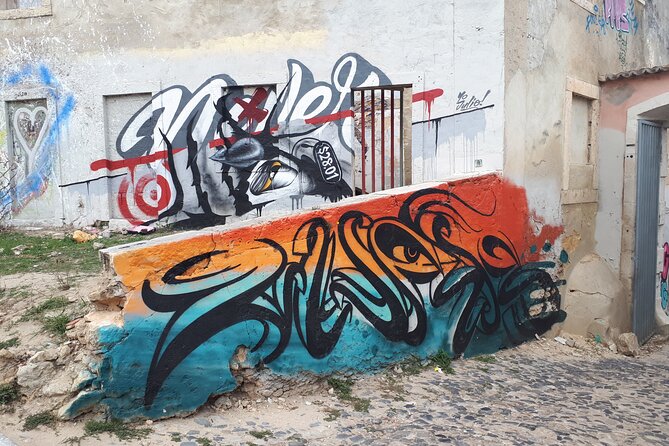
Lisbon is famous for tiled buildings, yellow trams, lookout points, and steep lanes. Street art adds another layer, one that changes more quickly than the city’s stonework.
On this walk, I would expect the guide to ask you to look up, around corners, and at small details that are easy to miss from a passing tram or taxi. A wall may show a large commissioned mural, while a nearby doorway carries a tiny stencil, paste-up, or painted symbol. The guide’s job is not only to point at color. It is to explain who made the work, what techniques were used, and how the art fits into local life.
The tour also gives you a useful distinction between legal street art and unauthorized graffiti. That matters in Lisbon, where some walls are planned projects and others are temporary acts of expression. You may see a piece that has changed since the guide last visited. The route is therefore not a fixed museum collection. It reflects the city as it is now.
The strongest part of the experience is its local focus. Instead of moving between famous sights by vehicle, you spend time in neighborhoods where people live. You see art in context, with old streets, hills, views, and ordinary buildings all part of the picture.
More murals and painted walls in Lisbon:
- Lisbon: Street Art Tour
★ 4.9 · 1,324 reviews - Lisbon: Kickstart Street Art Walking Tour
★ 4.9 · 717 reviews - Lisbon: Street Art Tuk Tuk Tour
★ 4.9 · 372 reviews
Starting at Largo da Graça
The tour begins at Largo da Graça 13, a central meeting point in the Graça area. Starting here makes sense because the route quickly moves into one of Lisbon’s most rewarding high neighborhoods.
The group is capped at 10 people. That is small enough for a guide to answer questions without shouting across a crowd, and useful when the group gathers around a narrow stairway or wall. It also helps if you want to ask about a particular artist or take time with a photograph.
The tour is offered in English and uses a mobile ticket. Confirmation is sent at booking. Public transport is nearby, so you do not need to arrange a private transfer to reach the meeting point.
Your guide may be a local artist or someone closely involved with Lisbon’s art community. Guides named in the available tour information include Diogo, Diego, Vero, Vera, Ben, and Luisa. The exact guide depends on the departure, but the experience is built around personal knowledge of the artists and their work. One guide is described as an anthropologist who studies Portuguese culture through street art, while others work as artists or with a local art collective.
That range matters. A general city guide can point out a mural. An artist can explain how the wall was made, why the composition works, or how a piece relates to other work nearby.
Mouraria and the Escadinhas de São Cristóvão
The first major section takes about an hour around the Escadinhas de São Cristóvão in Mouraria. This is where the tour begins to connect painted walls with Lisbon’s cultural identity.
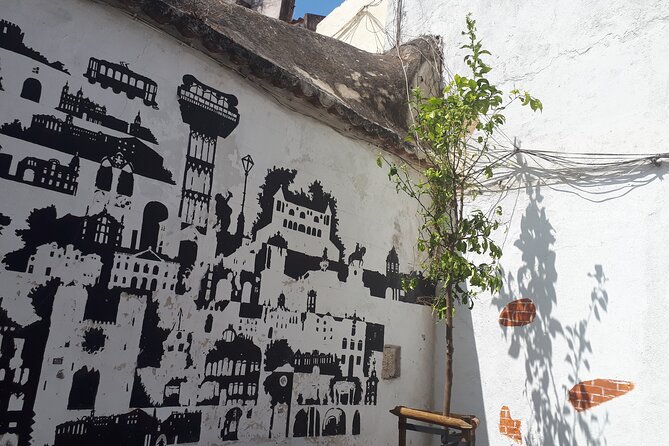
Mouraria is closely linked with the roots of fado, and the art here reflects more than decoration. You may see local characters, neighborhood scenes, and photographs of fado singers worked into the streets. The walls help tell the story of a place shaped by music, migration, daily life, and change.
The guide points out details that are easy to pass without noticing. A portrait may be placed where it has a direct connection to the street. A series of images may turn a stairway into an outdoor exhibition. A mural may use a local subject while also showing the hand of an artist known beyond Portugal.
This stop is especially useful if you want an introduction before the larger murals in Graça. The art is not presented as a list of famous names. Instead, you learn how the neighborhood itself appears in the work.
Photography is a natural part of this section. The narrow stairways, layered walls, and old façades create strong pictures, but be considerate when residents are using the same streets. This is still a living neighborhood, not a set built for sightseeing.
The climb to Miradouro da Graça

The route then takes you to Miradouro da Graça, also known as Miradouro Sophia de Mello Breyner Andresen. The stop lasts about 15 minutes, but the climb to reach it is the important part.
Graça sits high above central Lisbon. The uphill walk can be steep, and you may need to climb several flights of steps. The effort pays off with one of the city’s best viewpoints for seeing rooftops and the surrounding urban setting. From here, the art tour gains a wider frame: you are no longer looking only at individual walls, but at the neighborhoods spreading across Lisbon’s hills.
This is a good place to pause, catch your breath, and take photographs. If the weather is clear, the view can be one of the most memorable parts of the morning or afternoon. If it is hot, the climb will feel harder than the schedule suggests.
The tour description gives this stop only a short period, so do not expect a long viewpoint visit. Think of it as a scenic break within a walking route, not a separate sightseeing stop.
Same base, a different kind of day out:
- Lisbon City Center Tour – The Unmissable Lisbon
★ 5.0 · 22,234 reviews - Lisbon: Sintra, Pena, Regaleira, Cabo da Roca & Cascais
★ 4.7 · 19,656 reviews - Lisbon: Jerónimos Monastery Entrance Ticket
★ 4.1 · 14,164 reviews - Lisbon: History, Stories and Lifestyle Walking Tour
★ 4.8 · 10,902 reviews
Graça and São Vicente murals
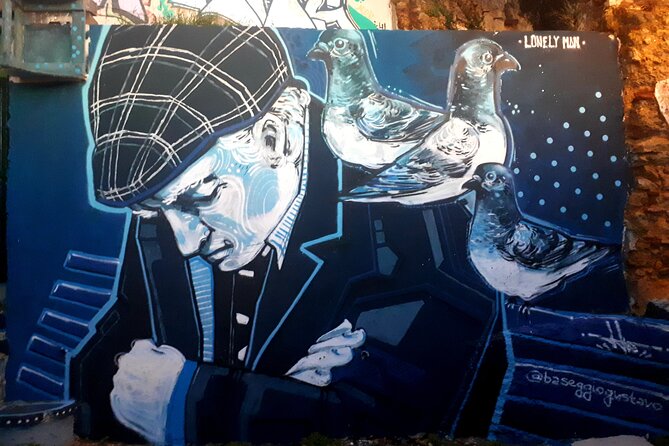
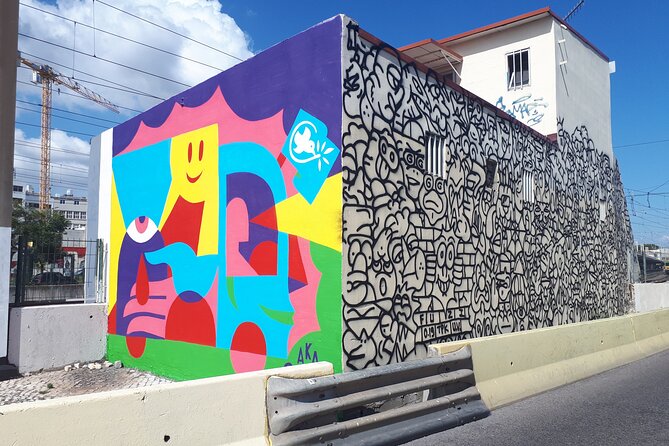
The longest section takes about 90 minutes through Graça and São Vicente. This is the heart of the tour, with large murals covering façades across one of Lisbon’s highest neighborhoods.
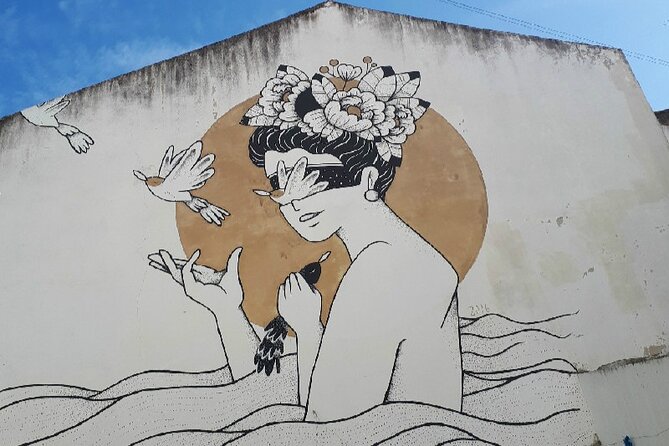
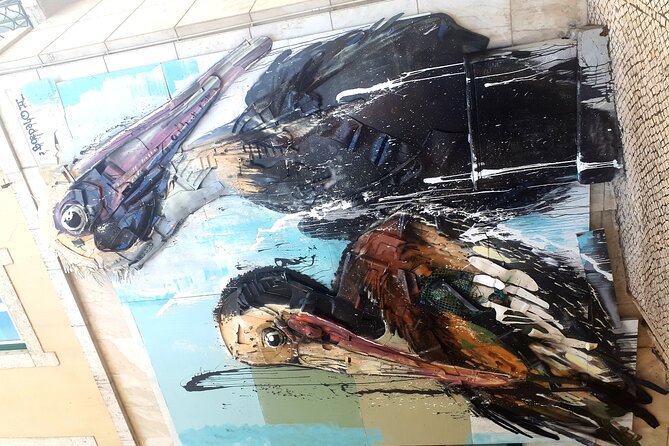
The art ranges from local work to pieces by international street artists. That mix gives the route variety. You might move from a wall rooted in neighborhood life to a bold, large-scale work with a style recognized far beyond Lisbon. The guide explains the people behind the work and the ideas that shape it.
You will also pass the tour company’s Walls of Fame. This makes the connection between the route and Lisbon’s street art community more direct. The guide can discuss not only finished pieces, but also how artists work together, secure permission, and respond to changes on the walls.
One useful feature is the tour’s attention to technique. You may learn how different materials and methods create different effects, why some pieces weather faster than others, and how artists use the shape of a building. The guide may also explain political and social messages, giving the art more meaning than a quick photo stop can provide.
The route is not only about the largest murals. Small details count. A painted face partly covered by newer work, a symbol tucked beside a doorway, or a fragment left from an earlier piece can show how quickly the scene changes. The guide may be surprised by a new addition or point out a recent project that has not yet been altered.
That changing quality is part of the appeal, but it also means you should not expect every piece seen on a previous departure to remain. The tour is best understood as an introduction to Lisbon’s outdoor art scene at a particular moment.
Jardim Botto Machado and the long azulejo wall

The final listed stop is Jardim Botto Machado, where you see a very long azulejo wall representing Lisbon through the city’s traditional tile art.
This is a useful contrast with the painted murals. Street art often changes quickly and may be bold, political, or personal. Azulejos connect to a more established Portuguese visual tradition, with repeated patterns, bright color, and carefully arranged surfaces.
The wall is described as the longest azulejo wall in the world. It gives you a strong final image and shows that Lisbon’s public art is not limited to spray paint or large modern murals. The city’s visual character comes from old and new forms sharing the same streets.
The stop lasts about 15 minutes. It is enough time to look closely and take pictures, but the tour does not turn into a full tile-history lesson. Its value is in the comparison between the wall you have just seen and the changing street art encountered earlier.
How hard is the walking?
Take the physical warning seriously. The route includes steep uphill and downhill sections, stairs, and a great deal of walking. Several people found the art worth the effort but also described the route as demanding on hot days.
You should wear comfortable walking shoes with a secure sole. Sandals that slip or thin city shoes will make the hills less pleasant. Bring water, and have breakfast or a snack before the tour because the full route can take the stated three hours, or longer if the group has many questions and the guide spends extra time explaining the work.
An umbrella or rain layer is sensible in January and during unsettled weather. There is no promise of shelter while the group is examining outdoor walls.
A moderate level of physical fitness is recommended. If stairs are difficult for you, this is probably not the right activity. The route is also a poor fit if you want a relaxed, mostly level introduction to Lisbon.
Service animals are allowed. The tour is near public transport, which helps with arrival and departure, though the final location can vary.
What the $24.20 price gets you
At $24.20 per person, this is a reasonable price for a three-hour, English-language walk with a maximum of 10 people. You are paying for interpretation and access to local knowledge rather than admission to a traditional attraction.
Every stop has free admission, so the value depends on the guide. If you walked the same neighborhoods alone, you would still see some murals, but you could easily miss the names, techniques, cultural references, and reasons behind them. You would also have to find the art yourself, and outdoor pieces can be tucked into side streets or partly obscured.
The price is strongest for anyone who wants context. It is less compelling if you only want to photograph large walls and do not care who made them or what they mean.
The small group adds value. Ten people is not private touring, but it is far more personal than a large city walk. Guides can speak with individuals, answer questions, and adjust the pace within reason. Some departures may be even smaller, which can lead to a longer or more conversational walk.
Free cancellation is available if you cancel at least 24 hours before the start time. Cancellations inside that period are not refunded, and changes are not accepted less than 24 hours before departure.
Who will enjoy this most?
I would choose this tour if you like art, urban culture, photography, or the less polished side of a city. It is particularly good for a first visit to Lisbon because it introduces several neighborhoods while giving you a reason to look beyond the usual sights.
It also suits solo visitors. The small group makes it easier to talk with other people, and the guide makes an effort to involve the whole group. Couples and families can enjoy it too, provided everyone is ready for the hills.
Art students, photographers, and repeat visitors will get more from the technical and cultural discussion. You may also leave with suggestions for other areas to explore on your own and ideas for restaurants or neighborhoods beyond the route.
I would skip it if you have limited mobility, dislike steep streets, or want a quiet sightseeing experience with little walking. I would also avoid scheduling it immediately before another fixed activity, since the walk can run beyond three hours when questions and discussion continue.
Should you book the Lisbon Street Art Tour?
Book it if you want to understand Lisbon through its walls, not just photograph them. The combination of Mouraria’s fado connections, Graça’s murals, the hilltop view, São Vicente’s streets, and the azulejo wall gives you a broad look at the city’s public art.
The best reason to go is the guide. A practicing artist or art specialist can show you details you would miss alone and explain the difference between a commissioned mural, graffiti, and other forms of street expression. That turns a walk into a lesson about Lisbon’s people and changing neighborhoods.
Book with sturdy shoes, water, weather protection, and enough time afterward to recover from the hills. If that sounds like your kind of outing, $24.20 is a fair price for a lively, local view of Lisbon.
FAQ
Where does the Lisbon Street Art Tour start?
The tour starts at Largo da Graça 13, 1170-364 Lisboa, Portugal. The meeting point is near public transportation.
Where does the tour end?
The stated end point is also Largo da Graça 13, but the walk may finish somewhere in the Graça or Alfama area depending on the time available and the group’s energy.
How long does the tour last?
The tour lasts approximately three hours. The route includes about one hour in Mouraria, 15 minutes at Miradouro da Graça, 90 minutes in Graça and São Vicente, and 15 minutes at Jardim Botto Machado.
Is the tour offered in English?
Yes. The tour is offered in English.
How many people can join?
The tour has a maximum of 10 people.
Can I cancel for a full refund?
Yes, if you cancel at least 24 hours before the experience starts. Cancellations made less than 24 hours before the start time are not refunded.
Just added in Lisbon
- From Lisbon: Horseback Riding on Comporta Beach★ 4.7 · 167 reviews
- Lisbon: City Highlights Segway Tour★ 4.9 · 422 reviews
- Lisbon: Street Art Tuk Tuk Tour★ 4.9 · 372 reviews
- Lisbon: Segway Medieval Tour of Alfama and Mouraria★ 4.9 · 420 reviews
- Évora and Monsaraz with Regional Wine Tasting from Lisbon★ 4.5 · 229 reviews
- Évora and Megaliths Full-Day Tour from Lisbon★ 4.7 · 456 reviews
- Arrabida and Sesimbra Small-Group Day Trip from Lisbon with Wine Tasting★ 5.0 · 494 reviews
- Lisbon Private Transfer to Airport★ 5.0 · 278 reviews