
Reviewed · AVEIRO & COSTA NOVA DAY TRIPS
Aveiro: Stories, Canals, and Azulejos Guided Walking Tour
Aveiro’s canals make a fine first impression, but the best part of this walk is learning what sits behind them. In two hours, you move from churches and azulejos to old ceramic factories, saltpans, lagoon boats, and the city’s unusual festivals. The route gives Aveiro a human scale that a quick canal-boat ride can miss.
I like the way the tour connects small details to larger stories, especially the black-and-white pavement, tiled shopfronts, and Art Nouveau ironwork. I also like the guide-led explanation of moliceiros, mercanteis, and the lagoon’s salt trade, subjects that are easy to overlook when you walk alone.
The main drawback is the walking itself. The route is not suitable for wheelchair users, people with mobility impairments, pregnant women, children under 10, or anyone with a low level of fitness. Museums and interiors may also have limited availability on some days, so the experience can focus more on exterior architecture.
Key points to know before booking
- A city walk with a local-history focus: You’ll see Aveiro through churches, canals, tiles, boats, salt, and local customs rather than just ticking off photo stops.
- Tony Walker may lead the tour: He is also referred to as Antonio or Tony and is described as a retired teacher with long experience living in Aveiro.
- The route covers several sides of Aveiro: Expect religious art, canal infrastructure, Beira Mar streets, Art Nouveau buildings, traditional boats, and salt-making history.
- You do not need to pay entry fees during the walk: The sites are viewed from outside or are free to enter when available.
- The tour costs $20 per person: For two hours with a live guide in English, Portuguese, French, or Spanish, that is a fair price if you want context rather than a simple orientation stroll.
- Wear proper walking shoes: The tour takes place in all weather and includes uneven city paving, open streets, and a route that is not designed for limited mobility.
Why this walking tour helps you see Aveiro
Aveiro is often presented as Portugal’s canal city, a label that can make it sound like a smaller version of Venice. That comparison is too thin. The canals are important, but Aveiro’s character comes from the relationship between the lagoon, salt production, ceramics, religious institutions, fishing, and the city’s later architectural revival.
This tour follows those connections on foot. You begin in the central Praça da República, then move through older streets and squares before reaching the canals and the Beira Mar neighbourhood. By the end, you have a better sense of why the city looks the way it does and why local traditions still matter.
I would take this walk early in an Aveiro visit. It gives you useful bearings for later wandering, and it may change the way you read the tiled façades and canal boats. The pace is intended for explanation, not for rushing from one landmark to the next.
Other guided walks in Portugal:
- Lisbon: History, Stories and Lifestyle Walking Tour
★ 4.8 · 10,902 reviews - Best of Lisbon Small-Group Guided Walking Tour
★ 5.0 · 4,869 reviews - Lisbon: Food and Wine Small Group Walking Tour
★ 4.9 · 4,082 reviews
Starting at Praça da República
The meeting point is near the statue in the centre of Praça da República. Look for the guide wearing a yellow and blue badge. This is a simple central starting place, but give yourself enough time to find the square without hurrying.
The first view includes Aveiro’s Town Hall and the Misericórdia Church. The square introduces two themes that continue throughout the walk: civic power and decorated religious buildings. You are not simply looking at old façades. You are beginning to see how the city expressed status through architecture, stonework, painted tiles, and carefully designed public spaces.
From here, the route follows Rua de Coimbra. The guide points out the black-and-white calçada à portuguesa, Portugal’s familiar patterned pavement. It is easy to treat this paving as background, but it is one of the small visual features that gives Portuguese towns their particular feel. The lesson is useful because you will notice similar paving elsewhere in Aveiro and across Portugal.
A small Baroque church and a large local story
At Marques de Pombal Square, the tour enters the Carmelite Convent Church. It is a small building, but the description of it as an impressive Baroque jewel is fair in practical terms: this is the kind of interior that can be missed if you only follow the main canal route.
The church gives the walk a change of mood. After the open square and pavement, you step into a more concentrated space shaped by religious decoration and Baroque design. Since the entry is free, the stop adds real value to a $20 tour, provided the church is accessible at the time of your visit.
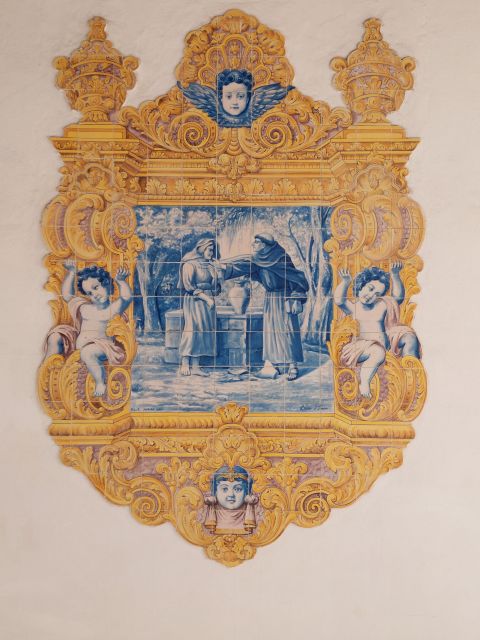
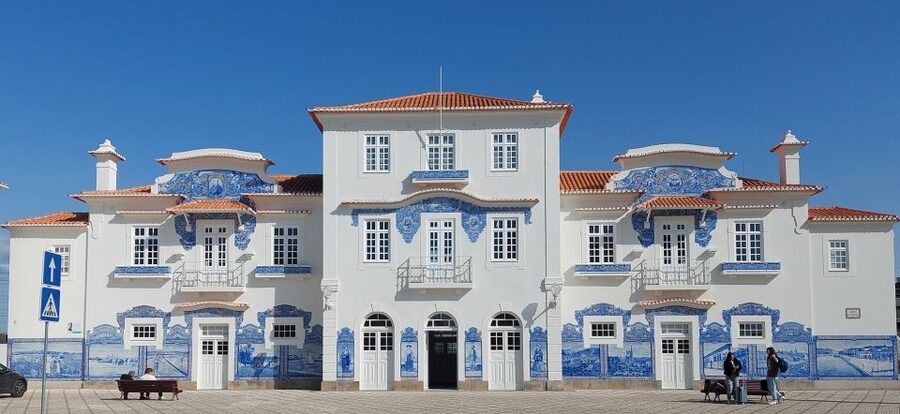
The route then passes Casa de Santa Zita and Sapataria Leão, both noted for their tile panels. These stops are useful because they show that azulejos are not limited to churches or grand monuments. Tiles also appear on ordinary commercial and residential façades, where they can serve as decoration, identity, and protection from weather.
Santa Joana and Aveiro’s religious centre
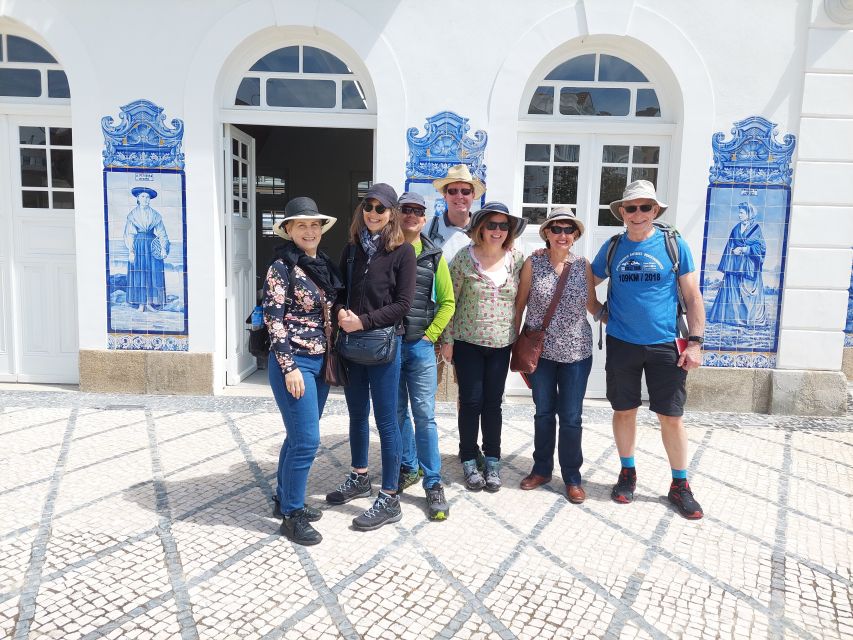
You pass beside the Dominican Convent of Jesus, linked to the story of Princess Santa Joana, the city’s patron saint. This is one of the points where a guide adds much more than a signboard. The story of a royal woman connected to a convent helps explain why this building matters to Aveiro and why Santa Joana remains part of the city’s identity.
The route continues past the cathedral. The sequence is well chosen: convent, saint, cathedral, then canals. You see that Aveiro’s religious landmarks are not scattered without reason. They belong to the older civic and spiritual centre of town.
If church interiors are your main interest, keep in mind that access can depend on opening times. A Monday visit, for example, may offer fewer open museums or interiors than a festival day. The walk still works, but part of the experience may shift toward exterior details and the guide’s explanation.
Other canal and lagoon days from Portugal:
- Aveiro: Traditional Moliceiro Boat Tour
★ 4.5 · 3,443 reviews - Aveiro and Costa Nova Half Day Tour from Porto with Boat Ride
★ 4.5 · 1,522 reviews - Aveiro: Scenic Guided Boat Tour
★ 4.4 · 1,047 reviews - Aveiro: Half-Day Tour from Porto with Cruise
★ 4.4 · 963 reviews
Canal da Fonte Nova and the working lagoon
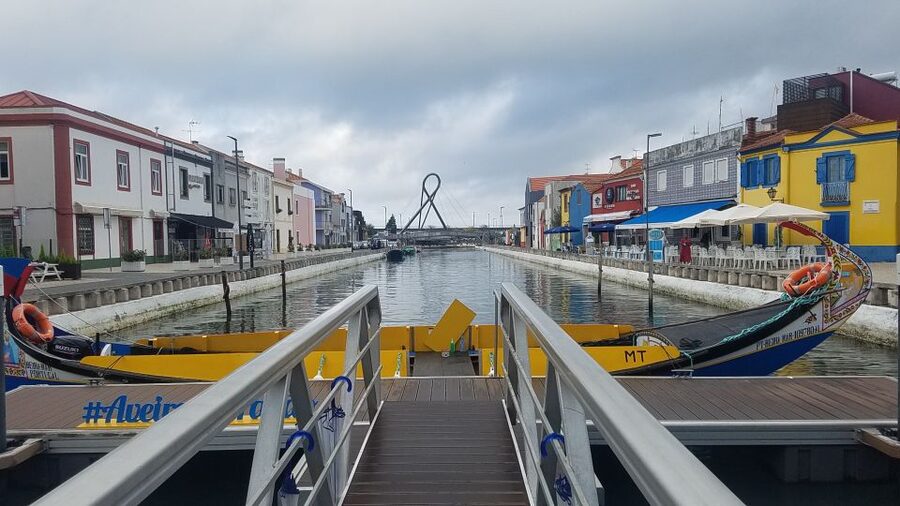
At Canal da Fonte Nova, the focus turns from religion to industry. One of the old ceramic factory buildings still remains beside the water. This is a valuable stop because it shows that Aveiro’s canals were not built only for sightseeing. They supported work, transport, and trade.
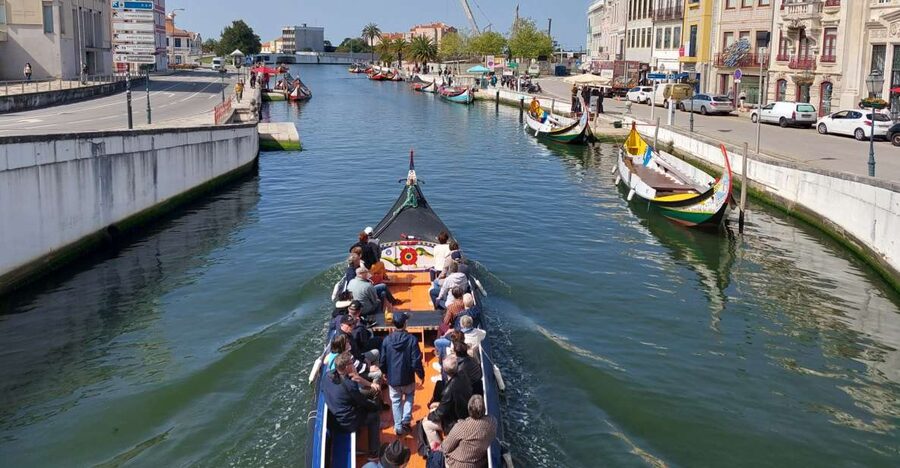
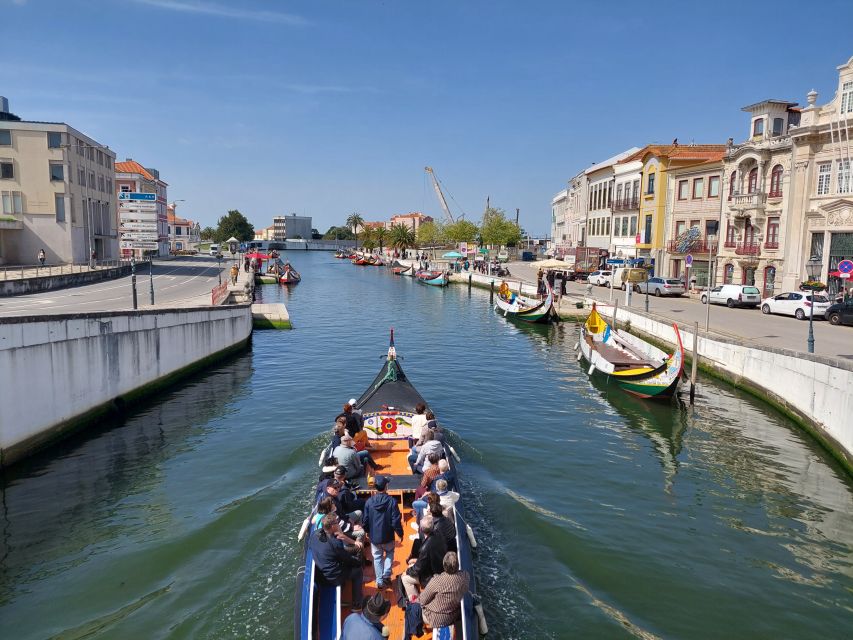
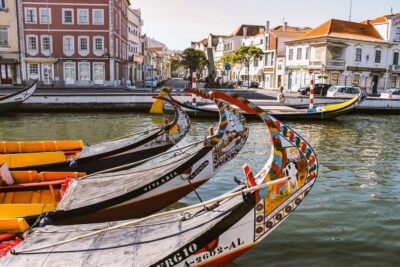
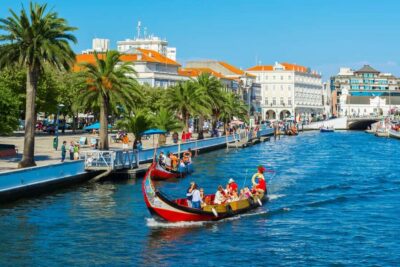
The guide explains how the canals developed and what purposes they served. You also learn to identify traditional boats from the Ria de Aveiro, including moliceiros and mercanteis. These names are worth learning because the boats are not all interchangeable.
Moliceiros are strongly associated with Aveiro’s public image, with their long, colourful forms and distinctive painted decoration. Mercanteis belong to the practical side of lagoon life. Knowing the difference helps you see the boats as working objects with different roles, not merely attractive props beside the water.
This is also the point where the lagoon’s smell and salt enter the story. Aveiro’s identity is tied to water that is useful, sometimes demanding, and closely linked to local work. That connection gives the canals more meaning than a simple scenic backdrop.
Beira Mar, tiled façades, and modern design
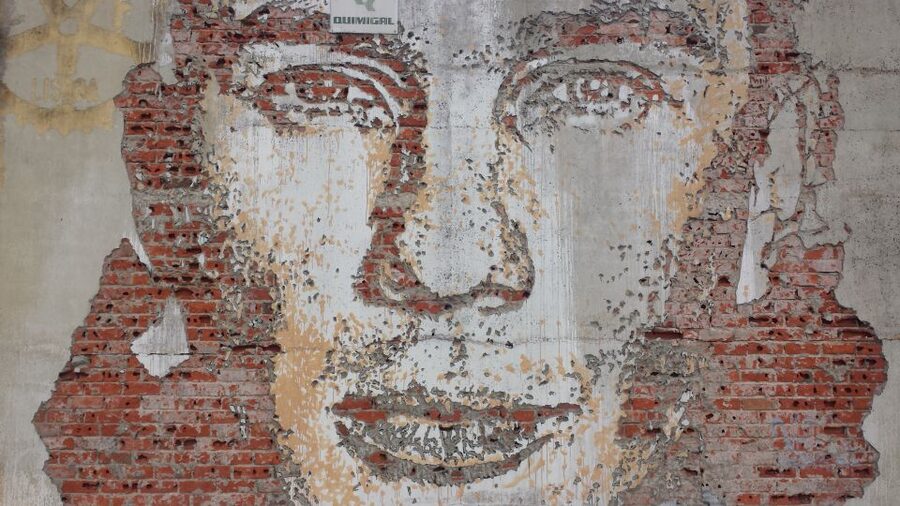
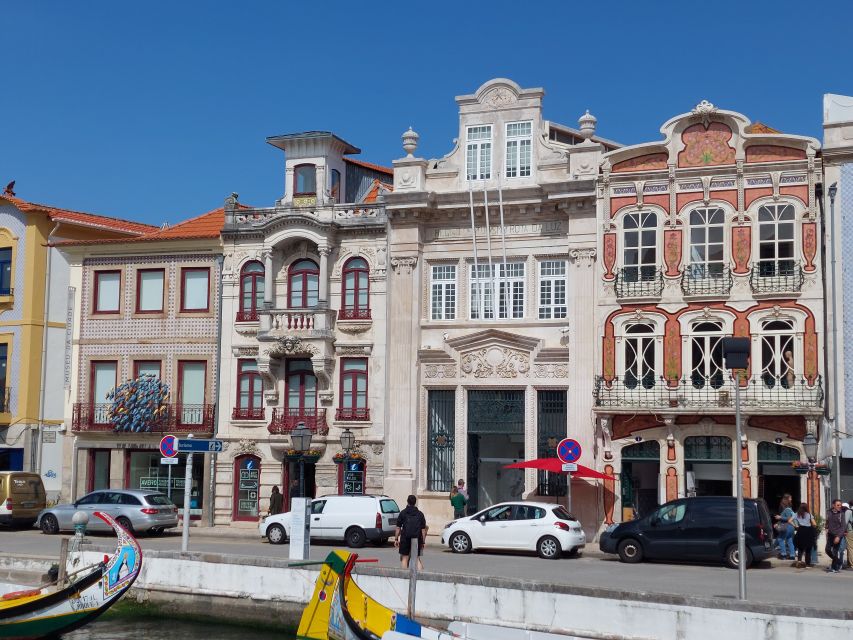
The route continues through the Beira Mar neighbourhood. Here, the tiles keep appearing, but the architectural vocabulary broadens. You look for Art Nouveau and Art Deco details, along with iron construction from the turn of the 19th to the 20th century.
This is one of my favourite parts of the route because it asks you to look upward and sideways. Aveiro’s character is often found in trim, balconies, tile patterns, window frames, and metalwork rather than in one massive monument. Without guidance, you could easily walk past these details.
The two façades of the Museum of Art Nouveau receive special attention. Even if you do not enter the museum, the exterior gives you a clear example of how the style appears in Aveiro. The stop also helps explain the city’s 19th-century revival, when new wealth and renewed confidence brought different forms of architecture into the streets.
The walk does not pretend that every building belongs to one period. That is part of its appeal. You move between early modern tiles, religious architecture, industrial remnants, Art Nouveau, Art Deco, and contemporary city life. The result is a layered view rather than a single postcard image.
Saltpans and Aveiro’s changing fortunes
On the way toward the saltpans, the guide places Aveiro’s story in a longer timeline. The city held power from the 11th to the 15th centuries, then endured a difficult period in the 17th and 18th centuries before finding new energy in the 19th century.
This historical arc matters because it explains why Aveiro can feel both old and renewed. You are not being shown a city frozen in its best period. You are hearing about decline, change, and recovery, which makes the canals, factories, churches, and newer façades easier to understand.
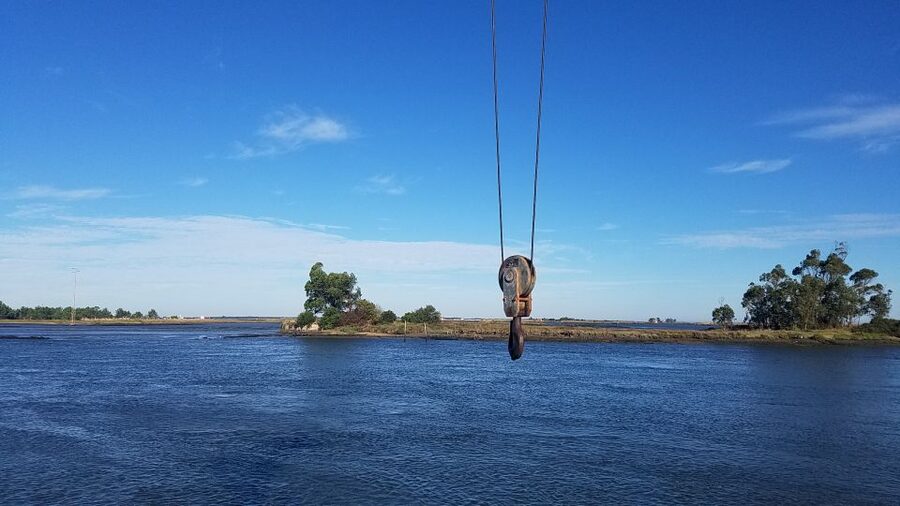
The saltpans connect the city to the lagoon in a direct way. Salt was not an abstract part of local history. It shaped work, trade, and the relationship between land and water. The walk does not turn this into a technical salt-production lesson, but it gives you enough context to recognise why the salt landscape belongs in Aveiro’s story.
The route to and from the saltpans also means you should take the practical side seriously. Bring sunscreen, dress for the weather, and wear shoes you can walk in for two hours. There is no promise of sunshine: the tour operates rain or shine.
Ovos moles, eel stew, and São Gonçalinho
As the route returns toward the centre, the guide introduces local food. Eel stew reflects Aveiro’s connection to the lagoon, while ovos moles are the city’s best-known sweet. The food discussion is brief, since meals are not included, but it gives you useful ideas for what to look for after the tour.
The final stop is the Church of São Gonçalinho. The guide explains the January festival held here, when a hard, heavy traditional sweet is thrown over the heads of the faithful. It is an unusual custom, full of noise, humour, devotion, and local memory.
This ending works because it brings together the main themes of the walk. You have seen formal churches and decorated façades, but you finish with a tradition that feels more communal and playful. São Gonçalinho is not just another church stop. It is a place where Aveiro’s identity is acted out in public.
The tour returns to the original meeting point. That makes it easy to continue with lunch, a canal boat trip, a museum visit, or more independent walking afterward. The boat trip is separate, so do not assume this walking tour includes a ride on a moliceiro.
Guide style and the value of local explanation
The named experience provider is Tony Walker, and the guide is also referred to as Antonio or Tony. When Tony leads the walk, his background as a retired teacher comes through in the way the stories are explained. He is particularly suited to people who like to ask questions, compare details, and understand the reasons behind what they see.
The strongest feature is not simply the number of stops. It is the connection between them. A tile panel leads to a discussion of materials and design. A canal leads to boats and salt. A convent leads to Santa Joana and the city’s religious past. Art Nouveau leads to Aveiro’s later revival.
That approach also gives the tour some flexibility. If a group takes longer with questions, the walk can run beyond the planned two hours. You should not count on extra time, but the guide’s style is clearly more conversational than a rigid script.
At $20 per person, I consider this good value if you want local interpretation. You are not paying for expensive admissions or transport. You are paying for two hours of explanation, a carefully chosen route, and the chance to notice details you might otherwise miss. If you prefer to walk alone and read signs at your own pace, the cost may feel less necessary.
Who should book this walk
I would recommend it to first-time visitors, architecture fans, people interested in Portuguese religious history, and anyone who wants more than a quick canal photograph. It is also a useful choice for a short stay because the route gathers several parts of Aveiro into one compact outing.
The tour suits you best if you are comfortable walking through streets and standing while listening. Bring only what you need. Large bags, luggage, bikes, alcohol, and drugs are not allowed, and baby carriages are not suitable for this activity.
The walk is not designed for children under 10 or for people with low fitness. It is also not suitable for wheelchair users or people with mobility impairments. Pregnant women should choose another activity. These limits are important, since the tour takes place outdoors and includes city paving rather than an accessible, seated route.
The language choices are English, Portuguese, French, and Spanish. At booking, check which starting time and language are available for your date. Cancellation is free up to 24 hours before the tour, and you can reserve now and pay later, which helps if your Aveiro plans are still moving around.
Should you book the Aveiro walking tour?
Book it if you want Aveiro explained rather than simply photographed. The strongest reasons are the mix of canals, churches, azulejos, ceramic industry, saltpans, and local customs, plus the chance to walk with Tony Walker or another live guide in your chosen language.
Skip it if you need step-free access, dislike walking in uncertain weather, or mainly want a boat ride. In that case, choose a separate canal cruise or a shorter independent stroll.
For most visitors who have two hours and want to understand why Aveiro looks and feels different from other Portuguese cities, this is a sensible first activity. It gives you the stories behind the tiles, the boats, and the salt, then leaves you free to explore the city on your own.
FAQ
How long does the Aveiro walking tour last?
The tour lasts two hours. Starting times vary, so check availability for your chosen date.
Where does the tour start?
Meet near the statue in the centre of Praça da República. The guide will be wearing a yellow and blue badge.
Where does the tour finish?
The activity finishes back at the original meeting point.
Which languages are available?
The live guide can conduct the tour in Portuguese, French, English, or Spanish.
Does the tour include food or drinks?
No. Food and drinks are not included.
Does the tour include a canal-boat ride?
No. The walk explains Aveiro’s traditional boats, including moliceiros and mercanteis, but a boat trip is not included.
What should I bring?
Bring comfortable shoes, sunscreen, weather-appropriate clothing, and a passport or ID card.
Is the tour suitable for wheelchair users or people with limited mobility?
No. The tour is not suitable for wheelchair users, people with mobility impairments, pregnant women, people with low fitness, or children under 10.
More pastel de nata workshops in Portugal
- Lisbon: Pastel de Nata Baking Class
★ 4.9 · 2,106 reviews - Porto: Pastel de Nata Cooking Class with Grandma’s Recipe
★ 5.0 · 1,565 reviews - Porto: Pastel de Nata Pastry-Making Workshop
★ 4.9 · 1,542 reviews - Porto: Pastel de Nata Cooking Class with Port Wine – Sé
★ 4.8 · 888 reviews
Just added in Portugal
- Half day Spa Water Therapy experience at THE SPA at Corinthia Lisbon★ 4.5 · 51 reviews
- Lisbon Cinematic Photoshoot with Top-Rated Photographer★ 5.0 · 76 reviews
- Central Lisbon E-Bike Tour★ 5.0 · 168 reviews
- Small-Group Sailing Tour on the Tagus River from Lisbon★ 5.0 · 78 reviews
- Lisbon Sailing Catamaran Public Cruise with drinks★ 5.0 · 304 reviews
- Alfama and the Castle of Saint George Skip the line Tour★ 5.0 · 53 reviews
- City Centre Run in Lisbon★ 5.0 · 164 reviews
- Boat tours in the Óbidos Lagoon★ 5.0 · 100 reviews
Aveiro & Costa Nova Day Trips, compared.

Aveiro and Costa Nova Half Day Tour from Porto with Boat Ride
Read our review →
Aveiro, Paiva Walkways and Arouca 516 Footbridge
Read our review →
Porto to Lisbon Up to 4 Stops: Aveiro, Nazare, Fatima & Obidos
Read our review →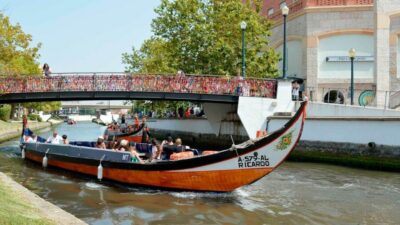
Aveiro, Cruise, Costa Nova & Capelha da Pedra Full Day
Read our review →Browse the lists this tour appears in