
Reviewed · LISBON NEIGHBOURHOOD WALKS
Alfama Tour in Lisbon Old Town
Alfama is Lisbon at its most tangled and human: narrow lanes, worn stone steps, laundry overhead, old churches, and viewpoints opening suddenly over the rooftops. This 2.5-hour walking tour gives you a useful route through the district while tying the streets to Moorish rule, the 1755 earthquake, Fado, migration, and everyday life.
I like the strong storytelling, with guides such as Hugo, Cecilia, Claudia, Belen, and Fernanda bringing different parts of Alfama to life. I also like the small local touches, including stories about Fado and saudade, plus the chance to try ginjinha, sometimes served in a chocolate cup.
The catch is simple: Alfama is steep. You will climb hills and stairs, and the uneven streets can be tiring, especially in rain or strong heat. The meeting point can also be hard to spot among nearby churches and other tour groups, so arrive early and look for the blue umbrellas.
Key points to know before you go
- A full walk through Alfama: The route covers fountains, churches, murals, old lanes, and four major viewpoints.
- Tip-based pricing: The listed price is $3.62 per person, but a tip at the end is welcomed and expected.
- Strong local storytelling: Guides explain Fado, saudade, Moorish Lisbon, the Jewish quarter, dictatorship, empire, and local traditions.
- Steep streets and stairs: Comfortable walking shoes are essential, and a moderate level of fitness is advised.
- A useful first-day activity: The guide gives practical suggestions for food, sights, nightlife, and the rest of your Lisbon stay.
- A 3:30 pm English tour: The walk finishes in a different place from where it begins, near Lisbon Cathedral and the Church of St. Anthony.
Why Alfama works best on foot
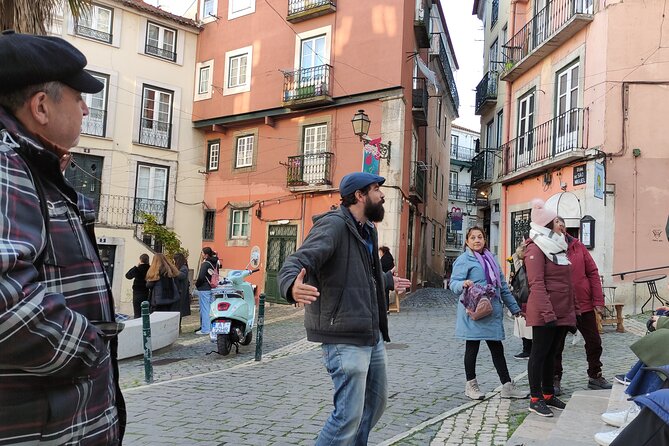
Alfama is not a district you understand by ticking off one monument at a time. Its character lies in the spaces between the sights: a lane too narrow for cars, a wall left from an older city, a small square where neighbors meet, or a sudden view across the Tagus.
That is the main value of this tour. You are not simply taken from one famous terrace to another. The guide helps connect the physical streets with the forces that shaped them. You hear about Roman remains, Moorish alleys, the old Jewish quarter, Lisbon’s colonial past, dictatorship, music, and migration.
The route is also a practical introduction to the district. After two and a half hours, you should have a better sense of where Alfama’s upper and lower sections meet, how the viewpoints connect, and which streets are worth revisiting on your own.
The group can reach 25 people, though some departures are much smaller. A small group makes it easier to ask questions and hear the guide in tight lanes. A larger group may slow the walking pace and make it harder to stay close, especially near crowded viewpoints.
Other quarters worth walking in Lisbon:
- Private Lisbon Sightseeing Tuk-Tuk Tour: Alfama, Belém & More
★ 5.0 · 4,277 reviews - Lisbon: Hills, Alfama, and Mouraria Tour by Electric Bike
★ 4.8 · 3,438 reviews - Lisbon: Fado in Chiado Live Show
★ 4.6 · 3,095 reviews
Beginning at Casa dos Bicos and the old waterfront
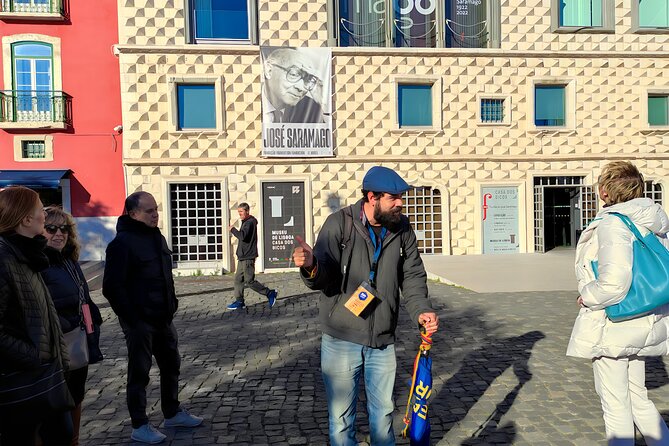
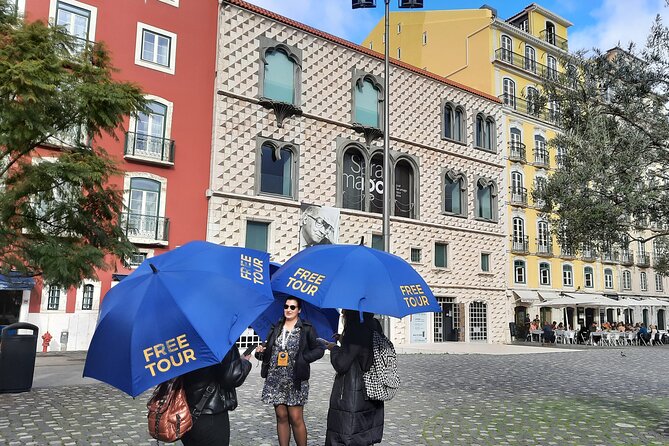
The tour starts at R. dos Bacalhoeiros 12A, near Casa dos Bicos, the striking building with its diamond-shaped stone facade. Look for the blue umbrellas, which serve as the meeting signal.
The opening stop lasts about 15 minutes. Casa dos Bicos is a useful place to begin because it puts you at the edge of Alfama, where the lower city rises toward the old quarter. Admission to the museum is not included, and the tour does not appear to be built around an interior visit.
This is also the point where you should make sure you have water, comfortable shoes, and anything you need for the next couple of hours. The route soon turns uphill, and there are no included food or drink stops. The ginjinha tasting sometimes associated with the walk is a small extra moment, not a substitute for carrying your own water.
Fountains that reveal old Lisbon
The next stop is Chafariz D’El Rei, probably Lisbon’s first public fountain. It dates to the 13th century and used water from the Alfama hillside.
A fountain can sound like a minor sight, but this one helps explain how the neighborhood functioned before modern plumbing. Water shaped where people lived, worked, and gathered. The stop is brief, about 10 minutes, and admission is free.
From there, the group reaches Largo do Chafariz de Dentro, once known as Chafariz dos Cavalos, or Horse Fountain. This is Alfama’s central plaza, and its name reflects its location within the Fernandina walls.
I find this section especially useful because it gives you a physical sense of the old fortified city. The square is not only a photo stop. It helps you picture Alfama as a working district enclosed by medieval defenses, rather than just a collection of pretty lanes.
At Largo de São Rafael, another 10-minute stop brings you beside an ancient wall. The guide uses this place to talk about older Alfama and the memories attached to its streets. The setting is modest, but that is part of the appeal. You get a pause from the main sights and a look at the pieces of the district that can be missed if you rush between viewpoints.
Small squares, local customs, and Saint Michael
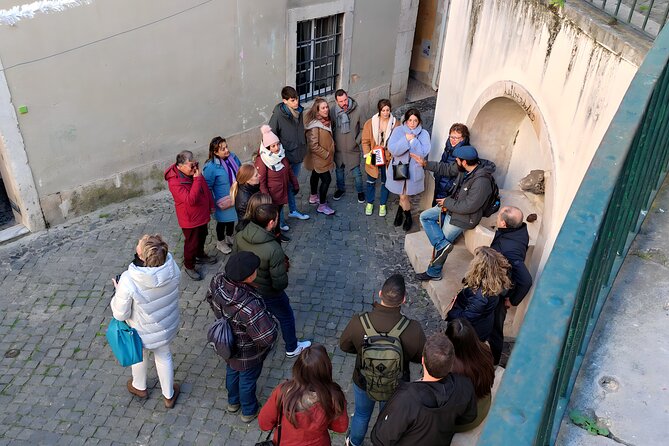
Largo do Salvador is another compact Alfama square. The group sits here to hear stories about customs and traditions that cross generations and cultures.
This is where the tour’s human side becomes more important than the buildings. A good guide can make a small square feel significant by explaining how people use it and what older habits still survive. Guides such as Claudia have been praised for keeping a careful pace, stopping in shaded spots, and allowing time for photographs and questions.
The route then reaches Igreja de São Miguel, one of the main places connected with Lisbon’s Popular Saints Festivities. The church and its square carry a strong connection to neighborhood celebrations.
The stop lasts about 15 minutes and admission is free. You should not expect a long interior visit or a formal religious tour. The value is in the setting and the stories: how local celebrations, churches, music, and street life overlap in Alfama.
Same base, a different kind of day out:
- Lisbon City Center Tour – The Unmissable Lisbon
★ 5.0 · 22,234 reviews - Lisbon: Sintra, Pena, Regaleira, Cabo da Roca & Cascais
★ 4.7 · 19,656 reviews - Lisbon: Jerónimos Monastery Entrance Ticket
★ 4.1 · 14,164 reviews - Lisbon: History, Stories and Lifestyle Walking Tour
★ 4.8 · 10,902 reviews
A mural and the climb into upper Alfama
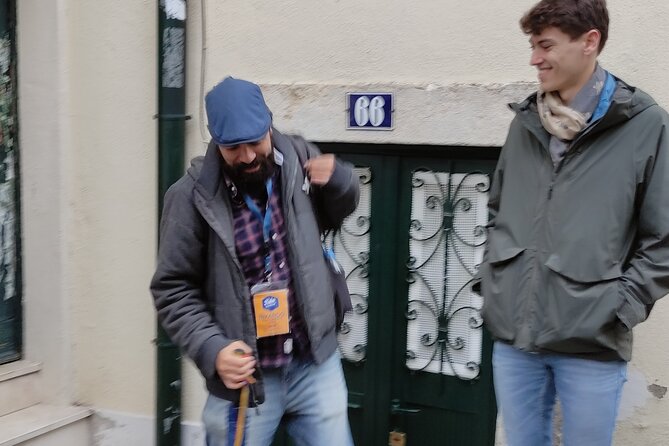
The History of Lisbon mural by Nuno Saraiva is one of the route’s more modern stops. It takes about 10 minutes and offers a change from churches, walls, and fountains.
The mural gives the guide a way to connect Lisbon’s past with its public art and modern identity. It also breaks up the walking route nicely. Alfama can begin to feel repetitive if every stop is another old facade, so a contemporary artwork adds variety.
After this, the tour moves into the maze of Alfama and climbs toward the Miradouro de Santo Estêvão. Depending on the group’s pace, the route may reach the church and viewpoint after working through the narrower lanes.
This is one of the places where good footwear matters most. The streets can be steep, and the climb may include stairs or uneven paving. The guides generally adjust the pace, but a slower group will naturally spend less time at later stops. If you have knee, balance, or mobility concerns, consider this carefully before booking.
Santo Estêvão, Portas do Sol, and Santa Luzia
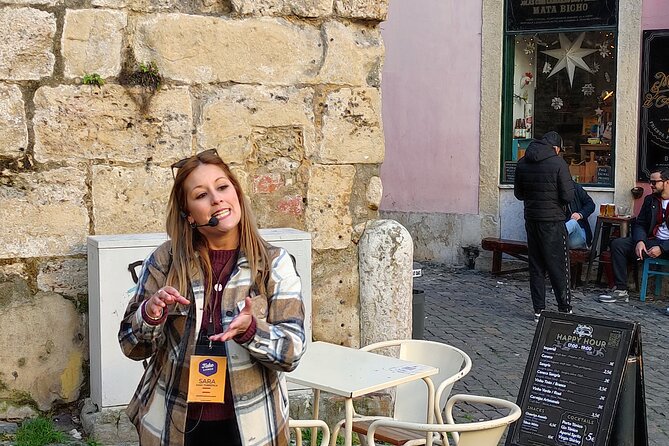
Miradouro de Santo Estêvão provides a quieter view than the most famous terraces. The stop lasts about 15 minutes, giving you time to look out across the rooftops and take photographs.
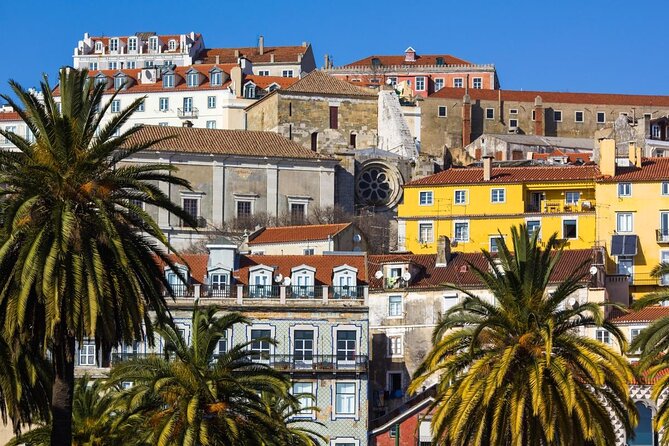
The better-known Miradouro das Portas do Sol comes next. This broad terrace is often described as one enormous balcony over Alfama. It is the kind of view that explains why Lisbon appears so often on postcards: terracotta roofs, the layered hillside, church towers, and the open water beyond.
You will want photographs here, but try to listen as well. A guide can point out how the city rises from the river and how Alfama’s lanes fit into the wider shape of Lisbon. The viewpoint is busy at times, and the group may need to stay together rather than spread out along the railing.
Miradouro de Santa Luzia follows, another 10-minute stop with a more romantic feel. Its tiled details and terrace make it one of Lisbon’s most recognizable corners.
The two viewpoints are close enough in character that some people may find the sequence a little repetitive. Still, the light and angle change, and the walk between them gives you more of Alfama than a quick taxi ride or a single viewpoint visit would.
Lisbon Cathedral and the Church of St. Anthony
The route descends toward Lisbon Cathedral, or Sé de Lisboa, the city’s oldest and most important church. Construction began in the 12th century.
The group spends about 15 minutes outside. Entry is not included, and the stated admission price is €5. If you want to see the cathedral interior, you will need to return separately or pay for entry during the visit if timing allows. Do not count on the walking tour itself providing a full cathedral visit.
Ending near the cathedral is useful because it places you in a central part of old Lisbon with easy access to other sights. It also creates a clear contrast with the upper viewpoints. You have moved from roof terraces and narrow lanes back toward the lower city.
The final stop is the Church of St. Anthony, devoted to Lisbon’s cherished saint. The tour ends here, in a different location from the starting point.
This is a sensible ending for a walk focused on local identity. By this stage, the guide can bring together religion, neighborhood traditions, Lisbon pride, and the stories heard along the route.
The stories make the difference
The strongest part of this activity is not the number of stops. It is the quality of the explanation between them.
Guides have covered the Moorish origins of Alfama, remnants of the Jewish quarter, the earthquake-resistant survival of its narrow streets, the Salazar dictatorship, colonization, empire, and migration. One particularly thoughtful explanation concerns a fountain whose tiles were defaced, reflecting the different lives of enslaved and free residents who once used it.
Fado also receives more than a passing mention. The guide may explain it as an emotional tradition shaped by longing, resilience, and departure, rather than simply presenting it as background music for dinner. The Portuguese word saudade becomes easier to understand when tied to the district’s stories and music.
The guides have different personalities. Cecilia has been described as energetic and a fine singer. Hugo is especially good at linking complicated subjects with clear storytelling. Claudia is attentive to group pace, while Belen brings enthusiasm to Moorish and modern Lisbon. Names can change from one departure to another, but the range of guide styles is worth keeping in mind.
You may also be offered a taste of ginjinha, Lisbon’s sour cherry liqueur. Some departures include it in a small chocolate cup, and it can be a memorable local touch. Any food or drink is not included in the tour price, so treat this as an optional extra.
Price, tipping, and what the low fare really means
At $3.62 per person, the listed price is unusually low for a 2.5-hour guided walk. The reason is that this is a fully tip-based tour. You pay a small booking amount, then offer a tip at the end based on the guide and the experience.
That changes how you should judge the value. The booking price is not the complete cost of the activity. You should budget for a fair tip, particularly if the guide gives you a well-paced, thoughtful walk and useful advice for the rest of your stay.
I like this model for visitors who want flexibility. It lets you try a guided introduction without committing to the price of a standard private tour. It also makes it important to act responsibly. Leaving without tipping defeats the purpose of the arrangement.
The tour includes the guide and local suggestions, but not meals, drinks, cathedral entry, or museum entry. Bring your own water and plan any interior visits separately.
Timing, meeting point, and practical planning
The stated start time is 3:30 pm. The activity information also indicates a choice of morning or afternoon departures, so check the exact time attached to your booking. Since the supplied schedule lists 3:30 pm, do not assume you can simply arrive at another hour.
Look for the blue umbrellas at Casa dos Bicos. The meeting area can be confusing because several groups may gather nearby, and two churches are within roughly 50 meters of one another. Arriving early gives you time to match the address, identify the guide, and avoid a rushed start.
The walk is offered in English. Service animals are allowed, and the meeting point is near public transportation. The maximum group size is 25 people.
Cancellation is free up to 24 hours before the start time for a full refund. Inside that window, the amount paid is not refunded, and changes are not accepted. The tour also requires a minimum number of participants, so a cancellation for that reason leads to an alternative date or experience, or a full refund.
Who should book this Alfama walk?
I would choose this tour if you want a clear introduction to Alfama before exploring alone. It suits first-time Lisbon visitors, people who enjoy local stories more than formal museum lectures, and anyone who wants practical ideas for the rest of the trip.
It is also a good choice for travelers interested in Fado, Portuguese customs, and the layers of Lisbon’s past. The guides do more than identify buildings. They explain why the neighborhood feels the way it does.
You should think twice if steep hills, stairs, or uneven paving are a serious concern. The pace can be adjusted, but the terrain cannot. You may also prefer a smaller private walk if you want long conversations at every stop or guaranteed access to church interiors.
Should you book it?
Book it if you want a lively, story-led walk through Lisbon’s oldest quarter, with major viewpoints, lesser-known corners, and advice from a local guide. The low booking price is attractive, but remember that tipping is expected.
The best reason to go is the combination of place and explanation. You see the fountains, walls, churches, mural, cathedral, and viewpoints, then learn how Fado, migration, religion, empire, and daily life shaped them. Wear serious walking shoes, arrive early for the blue umbrellas, carry water, and leave enough room in your afternoon for a steep but worthwhile walk.
FAQ
How long does the Alfama tour last?
The tour lasts approximately 2 hours and 30 minutes.
What time does the tour start?
The stated start time is 3:30 pm. The activity information also refers to morning or afternoon options, so check the exact time on your booking.
Where does the tour begin?
It begins at R. dos Bacalhoeiros 12A, 1100-070 Lisboa, Portugal, near Casa dos Bicos.
How do I find the guide?
Look for the blue umbrellas at the meeting point. The area can be confusing because several groups may gather nearby.
Where does the tour end?
The tour ends in a different location from the starting point, near the Church of St. Anthony after the Lisbon Cathedral stop.
Is the tour offered in English?
Yes. The tour is offered in English.
Is the tour free?
It is tip-based rather than fully free. The listed booking price is $3.62 per person, and a tip at the end is welcomed and expected.
Are food and drinks included?
No. Food and beverages are not included. Some departures may offer a ginjinha tasting, but any such purchase is separate.
Is Lisbon Cathedral admission included?
No. The group does not go inside the cathedral, and the stated entry price is €5.
How physically demanding is the walk?
You need a moderate level of fitness. Alfama has steep grades, stairs, and uneven streets, so comfortable walking shoes are important.
Just added in Lisbon
- From Lisbon: Horseback Riding on Comporta Beach★ 4.7 · 167 reviews
- Lisbon: City Highlights Segway Tour★ 4.9 · 422 reviews
- Lisbon: Street Art Tuk Tuk Tour★ 4.9 · 372 reviews
- Lisbon: Segway Medieval Tour of Alfama and Mouraria★ 4.9 · 420 reviews
- LISBON Street Art Tour★ 5.0 · 371 reviews
- Évora and Monsaraz with Regional Wine Tasting from Lisbon★ 4.5 · 229 reviews
- Évora and Megaliths Full-Day Tour from Lisbon★ 4.7 · 456 reviews
- Arrabida and Sesimbra Small-Group Day Trip from Lisbon with Wine Tasting★ 5.0 · 494 reviews
Lisbon Neighbourhood Walks, compared.

Private Lisbon Sightseeing Tuk-Tuk Tour: Alfama, Belém & More
Read our review →
Hills, Alfama, and Mouraria Tour by Electric Bike
Read our review →

Best of Lisbon Walking Tour: Rossio, Chiado & Alfama
Read our review →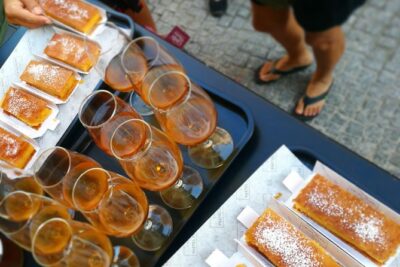
Lisbon Small-Group Food Tour with 18 Tastings in Alfama District
Read our review →
Baixa District Food Tour with Dinner and Drinks
Read our review →
Lisbon E-Bike Tour Commerce Square, Mouraria and Alfama
Read our review →
Browse the lists this tour appears in