
Reviewed · LISBON NEIGHBOURHOOD WALKS
Age of Discoveries Walking Tour in Belém
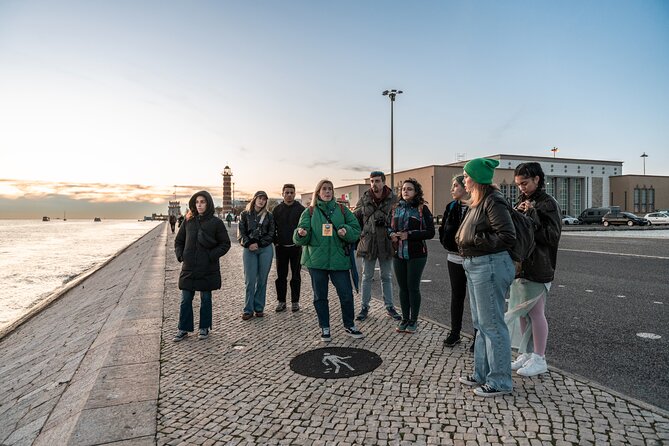
Belém tells Portugal’s story in grand stone, riverside gardens, and ships that once sailed toward unknown shores. This 2.5-hour walking tour links the district’s key sights, from Afonso de Albuquerque’s square to Belém Tower, while a guide explains how empire, trade, religion, and power shaped the country.
I like the very low price, just $3.62 per person, and the stop at Pastéis de Belém, where you can try the custard tart made famous in this neighborhood. I also like the clear route: you finish beside Belém Tower, so you can keep sightseeing there afterward.
The main drawback is pace. Eleven stops in two and a half hours means some explanations are brief, and the group can include up to 25 people. Guide quality also matters. Some guides, including Fernanda, Katerina, João, Claudia, Elena, and Sara, have earned especially warm praise, while one English departure was described as rushed and dull.
Key points to know before you book
- The walk covers Belém’s main monuments: You see the monastery, Compass Rose, Monument to the Discoveries, riverside, and tower.
- The pastel stop is a real highlight: You have time to buy the famous custard tarts at the bakery that created them.
- You pay mainly for the reservation: The tour is promoted as a free walk, with a small booking fee and an expected guide tip.
- Interiors are limited: You do not enter Belém Tower, the Monument to the Discoveries, or the monastery complex beyond the church.
- The route ends at Belém Tower: Plan extra time if you want to visit the tower inside afterward.
- A good guide makes a major difference: The strongest departures add historical context, local advice, and lively interpretation.
Why Belém works so well on foot
Belém is spread along the Tagus River, west of central Lisbon. Its sights are not packed into one small square, but they connect naturally by broad promenades, gardens, and open plazas.
This tour begins at the Garden of Afonso de Albuquerque and moves west toward the river and Belém Tower. You get a gradual introduction to the district rather than being dropped at its most famous monument with no context.
I like this order because the story grows as you walk. You begin with Portugal’s overseas expansion, pass through religious and royal symbolism, then reach the monuments built to celebrate navigation and empire. The ending beside the water gives the route a satisfying physical shape.
You should wear comfortable shoes. The walk is not presented as difficult, and most people can participate, but there are many stops and a fair amount of pavement. Near public transportation, the area is easy to reach, though private transportation is not included.
Other guided walks in Lisbon:
- Lisbon: History, Stories and Lifestyle Walking Tour
★ 4.8 · 10,902 reviews - Best of Lisbon Small-Group Guided Walking Tour
★ 5.0 · 4,869 reviews - Lisbon: Food and Wine Small Group Walking Tour
★ 4.9 · 4,082 reviews
Afonso de Albuquerque Square sets the historical tone
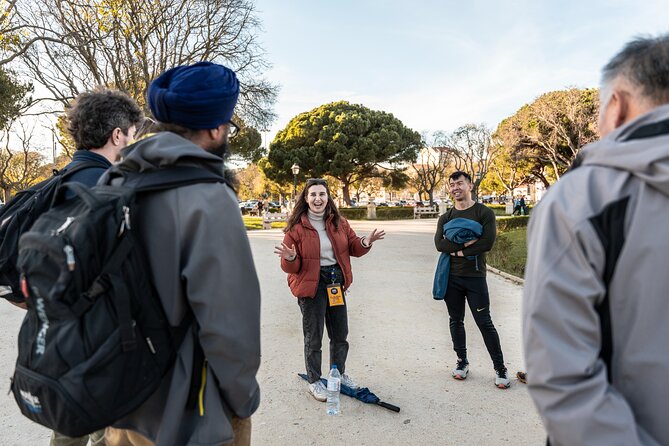
The meeting point is the Garden of Afonso de Albuquerque, at Praça Afonso de Albuquerque. The opening stop lasts about 15 minutes and introduces Afonso de Albuquerque, the Portuguese viceroy associated with expansion in the East.
The square offers more than a statue and a quick photograph. Its garden, sculptures, and decorative setting provide a useful first lesson in how Portugal remembered its imperial figures. Your guide can explain both the military success and the power behind the expansion.
This is also a practical meeting point. You are not starting inside a crowded monument or a confusing transport hub. Arrive ready to listen, since the first explanation helps make sense of the symbols you see later.
The Thai Pavilion reveals Belém’s wider connections
The Sala Thai, or Thai Pavilion, is a short 10-minute stop. It gives the tour a welcome change of focus: Portugal’s maritime story was not limited to the Atlantic.
The pavilion points toward connections with India, Thailand, and Sri Lanka. The guide also links those routes to tea and to Catarina de Bragança, whose marriage to Charles II helped make tea fashionable in Britain.
This stop is brief, so do not expect a full lesson on Asian trade. Its value is in widening the story. Portugal’s voyages were not simply about finding a sea route and planting a flag. They also carried food, customs, objects, and ideas between distant courts and ports.
Pastéis de Belém brings history to the plate
The stop at Pastéis de Belém lasts about 10 minutes and is one of the most useful parts of the route. You have a chance to buy the bakery’s famous custard tarts, made from the tradition associated with the monks of Jerónimos Monastery.
The tart is a pastel de nata, but the Belém version has its own name and reputation. The pastry is flaky, the filling is creamy, and the connection to the monastery gives the snack a clear place in the neighborhood’s story.
You should treat this as a purchase stop rather than a sit-down food tour. The schedule allows time to buy and taste, not a long meal. Some departures have helped the group move through the line efficiently, but you should not assume this will happen every time.
This is also where the low price needs a little explanation. The $3.62 charge is a reservation fee, not the cost of your pastry or a full paid guided excursion. You should budget for the tart and for a tip to the guide if you find the tour useful.
Same base, a different kind of day out:
- Lisbon City Center Tour – The Unmissable Lisbon
★ 5.0 · 22,234 reviews - Lisbon: Sintra, Pena, Regaleira, Cabo da Roca & Cascais
★ 4.7 · 19,656 reviews - Lisbon: Jerónimos Monastery Entrance Ticket
★ 4.1 · 14,164 reviews - Lisbon: Sunset Boat Party Cruise with DJ and Open Bar
★ 4.5 · 10,378 reviews
Chão Salgado adds a darker chapter
The Chão Salgado Alley stop lasts about 10 minutes and shifts the subject from overseas expansion to Lisbon’s internal politics.
Here, the guide discusses the Marquis of Pombal, the statesman who helped rebuild Lisbon after the 1755 earthquake and pushed major changes through the government. His record was not gentle. The Távora Massacre forms part of the darker side of his rule.
I appreciate this section because it keeps the walk from becoming a simple celebration of kings, explorers, and grand monuments. Portugal’s past includes reform and cruelty, confidence and fear. A strong guide can make this stop especially memorable by showing how power was used at home as well as abroad.
Jerónimos Monastery needs extra time afterward
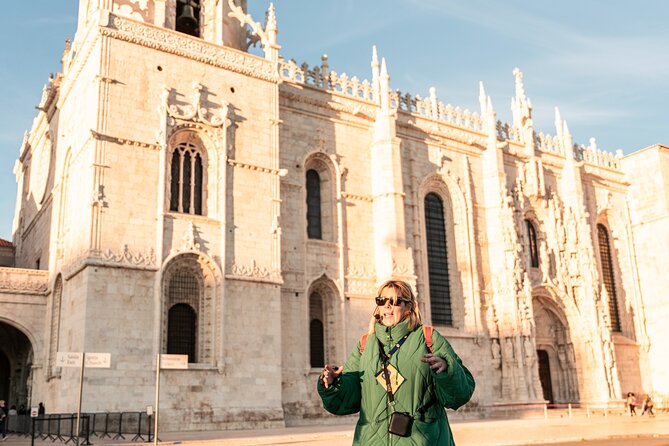
The church at Jerónimos Monastery is included in the walking route, while the broader monastery complex and cloisters are not. The stop lasts about 20 minutes.
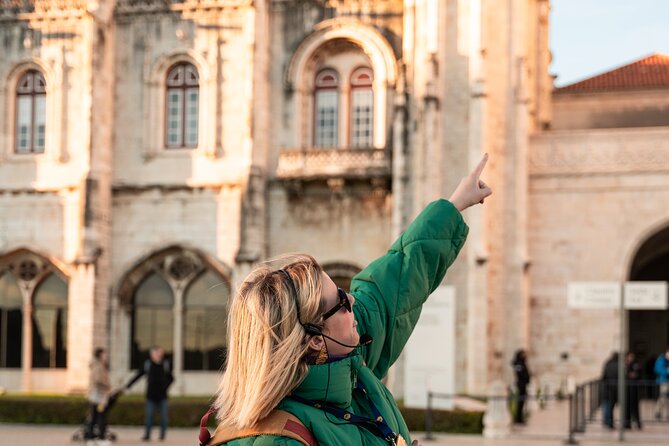
Even from the outside, Jerónimos is one of Belém’s essential sights. Its Manueline design uses maritime details, religious images, carved stone, and forms associated with Portugal’s seafaring age. The building was connected to the royal and religious ambitions of the period, and the guide explains how Prince Henry the Navigator fits into that story.
You should be clear about the limits before booking. This tour does not give you a full monastery visit. If you want the cloisters and the complete interior, plan a separate visit after the walk and allow enough time for that on your own.
The church portion can also be affected by crowd noise and the acoustics of the building. One guide received criticism for speaking too softly around crowds, so staying close to the guide matters here.
Praça do Império carries twentieth-century politics

The Praça do Império stop lasts about 15 minutes. Its gardens and large fountain were shaped by the 1940 New State World Exhibition, an event used to present Portugal’s national identity and imperial reach.
This is an important contrast with the earlier monuments. The square does not only commemorate medieval or early modern Portugal. It also shows how the twentieth-century Estado Novo government used architecture, gardens, and public ceremony to tell its preferred version of the nation.
The guide connects the plaza with Portugal’s founding in 1140, the end of Spanish rule in 1640, and the country’s long effort to define itself. The explanation is more useful than the view alone, since the open space can otherwise feel like simply a place to cross.
The Compass Rose makes navigation visible
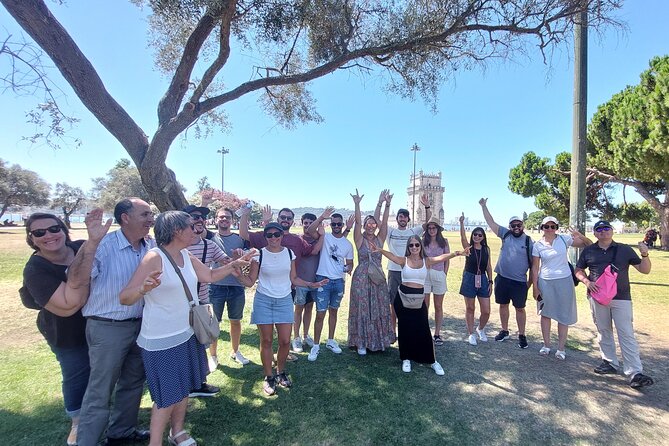
At the Rosa dos Ventos, you see the large Compass Rose and Mappa Mundi mosaic. The design covers roughly 50 meters and marks the routes and dates linked to Portuguese exploration.
This is one of the best photo stops, but it rewards a closer look. The map turns abstract navigation into something you can read under your feet. It shows how Portugal presented its voyages as a connected record of movement across oceans.
The guide’s explanation matters here. Without context, the mosaic can become a quick photograph and little else. With dates, names, and route details, it helps you understand how navigation changed Portugal’s place in the world.
The Monument to the Discoveries points toward the river
The Padrão dos Descobrimentos is a 15-minute stop. The enormous monument faces the Tagus, with figures associated with Portugal’s exploration arranged behind Prince Henry the Navigator.
You do not enter the monument on this tour. That keeps the walk moving, but it means you will need a separate visit if you want the interior or the upper viewpoint.
The monument is striking, yet it also needs careful explanation. Built in the twentieth century, it presents a proud version of the Age of Discovery and its leading figures. A good guide can help you see both the artistic power of the structure and the political message behind it.
This is a place where group size can matter. With up to 25 people, stay near the guide and make sure you can hear before the explanation begins. The wide riverside area can make voices carry poorly.
The riverbank connects exploration with modern Lisbon
The Belem Lighthouse and Tagus River Bank stop lasts about 10 minutes. Here, the old maritime story meets present-day Lisbon.
You look across the water toward the 25 de Abril Bridge and the Cristo Rei statue. The river is not just scenery. It is the route that connected Lisbon with the ships, cargo, people, and ambitions discussed earlier.
The guide also brings in Gago Coutinho, the aviation pioneer associated with a pioneering transatlantic flight. That detail broadens the idea of exploration beyond wooden caravels. Portugal’s story of crossing distances continued into the age of aviation.
This part of the walk is especially pleasant in good weather. The tour requires suitable weather, and the riverfront is exposed, so a rainy or windy day can make the final stretch less comfortable.
Belém Tower is the proper finish
The Belém Tower gardens are a 15-minute stop, followed by about 20 minutes at the tower itself. The tour ends beside Torre de Belém, on Avenida Brasília.
The tower was built to guard the entrance to Lisbon and later became one of the clearest symbols of Portugal’s maritime past. Its Manueline decoration combines military purpose with ornate carving, giving it a look that is both fortress-like and ceremonial.
You do not enter the tower during the tour. That is not a flaw if you see the walk as an introduction. In fact, finishing here gives you a simple choice: take photographs, walk along the river, or visit the tower separately if it is open and you have time.
The gardens provide room to pause after the steady sequence of stops. I like ending here because the tower, water, bridge, and open sky bring the whole route together without requiring another transfer.
What the $3.62 price really means
At $3.62, this is an unusually cheap way to get a structured introduction to Belém. You are paying a small reservation fee for an English-language free tour, then deciding what tip feels fair for the guide’s work.
That model can offer excellent value. The tour covers sights that would otherwise require you to research and connect yourself, and it adds stories to places that can look impressive but confusing when seen alone.
It is not a substitute for paid entry to the monuments. You still need to pay separately for any interior visits, and you pay for your own food at Pastéis de Belém. Think of the tour as a guided orientation, not an all-inclusive attraction pass.
The average booking lead time is about 24 days, which suggests that popular dates can fill ahead of time. The maximum group size is 25, so this is not a private walk. Guide quality can vary, making the tip especially dependent on how clear, engaging, and useful your particular departure feels.
Who will get the most from this walk
I would recommend this tour to a first-time Lisbon visitor who wants the main Belém sights explained in one outing. It suits budget-minded people, history fans, and anyone who prefers to see a district on foot before choosing which monuments deserve a separate ticket.
It is also a good fit if you want practical suggestions for the rest of your Lisbon stay. Guides such as Fernanda and João have been praised for offering advice on places to eat and things to do nearby, while Katerina, Claudia, Elena, and Sara have been singled out for clear historical explanation and personal energy.
You may want a different plan if you dislike group walks, want long museum visits, or prefer to move quickly. One family found the two-hour-plus route too slow and would have preferred a shorter visit. Another departure was criticized for rushing and skipping important material, so the quality of the individual guide remains the biggest variable.
Free cancellation is available up to 24 hours before the start time. Changes or cancellations inside that window are not refunded, and poor weather or an insufficient number of bookings can lead to a rescheduled tour or full refund.
Should you book the Age of Discoveries Walking Tour?
Book it if you want a cheap, guided introduction to Belém and understand that the monument interiors are mostly left for later. The pastel stop, riverfront route, and final view of Belém Tower give you plenty for the small booking fee.
Skip it if you already know Belém well, need a fast one-hour visit, or want guaranteed depth inside Jerónimos Monastery and the tower. If you do book, arrive prepared to walk, stay close enough to hear the guide, and reserve extra time after the tour for the monuments you want to enter.
FAQ
How much does the Age of Discoveries Walking Tour cost?
The listed price is $3.62 per person. It is a free-style walking tour with a small reservation fee, and a tip for the guide is generally expected if you find the tour worthwhile.
How long does the tour last?
The walk lasts approximately two hours and 30 minutes.
Is the tour offered in English?
Yes. The experience is offered in English and uses a mobile ticket.
Where does the tour begin and end?
It begins at the Garden of Afonso de Albuquerque, Praça Afonso de Albuquerque, Lisbon. It ends beside Belém Tower on Avenida Brasília.
Do I enter Jerónimos Monastery, the Monument to the Discoveries, or Belém Tower?
You do not enter the full Jerónimos Monastery complex, the Monument to the Discoveries, or Belém Tower as part of this tour. The church at Jerónimos is included, and you can visit the other interiors separately afterward.
Can I cancel the booking?
You can cancel up to 24 hours before the start time for a full refund. Cancellations or changes made less than 24 hours before the tour are not refunded. The tour may also be rescheduled or refunded if poor weather or low booking numbers cause cancellation.
More neighbourhood walks in Lisbon
- Alfama Tour in Lisbon Old Town
★ 5.0 · 4,936 reviews - Private Lisbon Sightseeing Tuk-Tuk Tour: Alfama, Belém & More
★ 5.0 · 4,277 reviews - Lisbon: Hills, Alfama, and Mouraria Tour by Electric Bike
★ 4.8 · 3,438 reviews - Lisbon: Fado in Chiado Live Show
★ 4.6 · 3,095 reviews
Just added in Lisbon
- From Lisbon: Horseback Riding on Comporta Beach★ 4.7 · 167 reviews
- Lisbon: City Highlights Segway Tour★ 4.9 · 422 reviews
- Lisbon: Street Art Tuk Tuk Tour★ 4.9 · 372 reviews
- Lisbon: Segway Medieval Tour of Alfama and Mouraria★ 4.9 · 420 reviews
- LISBON Street Art Tour★ 5.0 · 371 reviews
- Évora and Monsaraz with Regional Wine Tasting from Lisbon★ 4.5 · 229 reviews
- Évora and Megaliths Full-Day Tour from Lisbon★ 4.7 · 456 reviews
- Arrabida and Sesimbra Small-Group Day Trip from Lisbon with Wine Tasting★ 5.0 · 494 reviews
Lisbon Neighbourhood Walks, compared.

Private Lisbon Sightseeing Tuk-Tuk Tour: Alfama, Belém & More
Read our review →
Hills, Alfama, and Mouraria Tour by Electric Bike
Read our review →

Best of Lisbon Walking Tour: Rossio, Chiado & Alfama
Read our review →
Lisbon Small-Group Food Tour with 18 Tastings in Alfama District
Read our review →
Baixa District Food Tour with Dinner and Drinks
Read our review →
Lisbon E-Bike Tour Commerce Square, Mouraria and Alfama
Read our review →Browse the lists this tour appears in