

Reviewed · FÁTIMA, BATALHA & NAZARÉ DAY TRIPS
Tomar: Convent of Christ and Templar Castle Tour Ticket
Tomar’s Convent of Christ is the kind of place that rewards slow looking. Inside one fortified hilltop complex, you move from the rough stone defenses of a Templar castle to a Renaissance convent filled with carved Manueline details, five cloisters, and the remarkable round Charola chapel. I especially like the way the site lets you read Portugal’s changing past in its buildings, rather than through a long museum label.
I also like the rare Charola temple, inspired by Jerusalem’s Holy Sepulchre, and the Chapter Window, whose stonework points to Portugal’s maritime age. The main thing to watch is the wording of your booking: this is priced at $17 and includes entry, but the experience may function mainly as a self-guided visit. Guides Mark and Anna are praised for making the history clear, yet you should confirm that a guide is included in your selected option.
Key points to know before you go
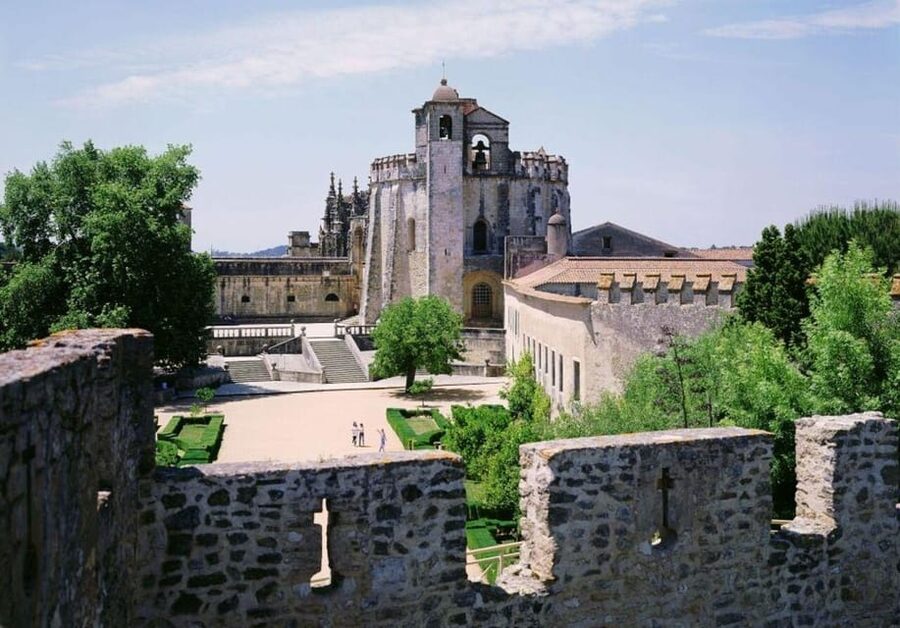
- The Charola is the architectural star: This unusual round temple gives the former Templar headquarters its most memorable interior.
- Five cloisters show five different moods: You’ll see styles ranging from Gothic to Mannerist as you move through the convent.
- The $17 price is strong for the site: Entry covers the Convent of Christ, though meals, drinks, and personal spending are not included.
- The guide question matters: Mark and Anna are named as effective guides, but one booking was understood as an entry ticket rather than a guided tour.
- Allow time for details, not just photographs: The Manueline nave, High Choir, Chapter Window, and aqueduct reward a measured pace.
- Come prepared for a historic stone complex: Wear comfortable shoes, bring a hat and sunscreen, and arrive 15 minutes early.
Why Tomar’s Convent of Christ deserves your time

The Convent of Christ is not one building. It is a long architectural story gathered inside and around the old Templar stronghold. The complex was inscribed on the UNESCO World Heritage List in 1983, and that designation makes sense once you see how many periods meet here.
The castle began in 1160, when the Templars built a fortified base above Tomar. Later, the Order of Christ used the site, and the complex grew into a large convent. The result is not tidy or uniform. Medieval walls sit beside Renaissance courtyards, while Manueline stone carving brings in the age of Portuguese sea exploration.
That mixture is the appeal. You do not simply enter a church, look around, and leave. You pass through military spaces, religious rooms, cloisters, choir areas, and decorated architectural features. Each change in style gives you another clue about how the site developed.
For me, the best way to approach the visit is to treat it as a sequence of contrasts. The castle feels defensive and severe. The convent feels ordered and ceremonial. The Charola feels unlike either one.
Other days north from Portugal:
- Three Cities in One Day: Porto, Nazare and Obidos from Lisbon
★ 4.5 · 3,572 reviews - From Lisbon: Fátima, Nazaré, Batalha, and Óbidos Guided Tour
★ 4.7 · 3,060 reviews - From Lisbon: Fatima Batalha Nazaré & Óbidos Small-Group Tour
★ 4.7 · 2,563 reviews
Starting at the Templar Castle
Your visit begins at the main entrance of the Convent of Christ. The meeting point is also the end point, so you should be able to continue exploring Tomar afterward without needing to find a separate return location.
The first major part is the Templar Castle, founded in 1160. Its medieval fortifications give the complex a strong sense of place. Look for the practical side of the site first: thick walls, defensive planning, and the elevated position that made the stronghold useful.
This is not a reconstructed theme-park castle. The value lies in seeing how a religious military order organized a fortified headquarters. The stonework and layout help explain why the Templars needed protection and why this location mattered.
You might find that the castle portion feels less decorated than the convent. That is not a weakness. It sets up the contrast that follows. The plain defensive character makes the later carved windows, cloisters, and church interiors feel even more dramatic.
If you have a guide, this is where clear historical explanation can make a real difference. One guide, Mark, is specifically praised for putting the history together and covering the main high points. Anna is also praised for explaining difficult ideas in a simple, interesting way. If your ticket is self-guided, take your time with the route and avoid rushing through the outer walls.
The round Charola and its Jerusalem connection
The Charola is the site’s most unusual feature. This round-shaped temple was inspired by the Holy Sepulchre in Jerusalem, and its form immediately separates it from a typical rectangular church.
The shape matters because it reflects the Templars’ connection to the Holy Land. You do not need a long lecture to understand that this was meant to be a special religious space. The circular plan changes the way you experience the room, directing your attention around the center rather than toward one long aisle.
The Charola also gives the visit an emotional pause. After the castle’s military lines, you enter a space built for ceremony and devotion. The connection to Jerusalem adds another layer, linking this Portuguese site to the wider medieval world.
Look carefully rather than treating it as a quick photo stop. The round plan is the key detail, but the wider importance comes from seeing how the Templars expressed their identity through architecture. A guide can help explain the symbolism, but even without one, this is the room you are least likely to forget.
Flash photography is not allowed. Photography without flash is permitted, so you can take pictures, but be considerate in darker interiors and avoid letting the camera distract you from the room itself.
From military headquarters to Renaissance convent
The next stage moves into the Renaissance Convent of the Order of Christ. Here the mood changes from fortress to religious institution. The complex grew over several centuries, so you will see different architectural languages rather than one perfectly matched design.
The Manueline nave is a major highlight. Manueline architecture is closely tied to Portugal’s maritime expansion, and its carved details often feel more expressive than the surrounding structure. The nave gives you a clear sense of the convent’s ceremonial importance.
The High Choir is another important stop. Its position and scale help you understand how the religious community used the church. This is one reason I would not rush directly to the most photographed features. The large spaces give context to the smaller carvings.
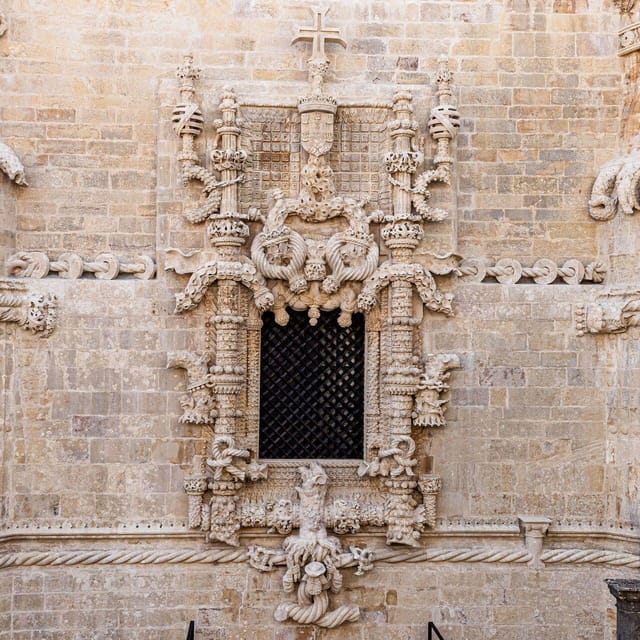
Then look for the Chapter Window. It is one of the most recognizable details in the complex, and it is often read as a symbol of Portugal’s seafaring ambitions. You will want to examine it from different angles if the space allows. From a distance, it works as a strong visual focal point. Up close, the carving rewards patience.
The site’s decoration can be easy to overload. Instead of trying to identify every motif, choose a few details and notice how they relate to Portugal’s royal and maritime history. That approach makes the visit more memorable and keeps the church from becoming a blur of stone ornament.
A few more things to do in Portugal worth a look
- Sintra: Pena Palace and Park Entrance Ticket
★ 4.2 · 17,410 reviews - Lisbon: Jerónimos Monastery Entrance Ticket
★ 4.1 · 14,164 reviews - Lisbon: Oceanário de Lisboa Entrance Ticket
★ 4.6 · 9,943 reviews - Porto: Torre dos Clerigos Entrance Ticket
★ 4.6 · 6,395 reviews
Five cloisters, five different architectural chapters
The convent contains five distinct cloisters. This is one of the best reasons to allow enough time for the full visit. A single courtyard might be beautiful, but five courtyards let you compare how architectural taste changed over time.
You are likely to notice styles ranging from Gothic to Mannerist. The cloisters offer quieter spaces after the larger church interiors, and their repeated arches make a good framework for spotting differences in proportion, decoration, and mood.
Do not assume that the first cloister is the best one. The point is the sequence. Move from one to the next and pay attention to how the design shifts. Some may feel more restrained, while others show greater refinement or ornament.
The cloisters are also practical places to slow down. If the main church feels visually crowded, a courtyard gives your eyes a rest. You can study the stonework, frame photographs without flash, and think about the daily life of the religious community that used these spaces.
A guide is useful here because the differences can otherwise seem subtle. Mark’s praised ability to connect the history would be especially helpful in this part of the visit. If you are touring alone, focus on the broad progression from Gothic forms toward later Renaissance and Mannerist design.
The Pegões Aqueduct and the larger Tomar setting
The grand Pegões Aqueduct adds a major engineering feature to the visit. It dates from the period of the Spanish King Filipe and was built to serve the convent’s water needs. Its long run of arches gives the complex a different scale from the castle and courtyards.
The aqueduct is worth seeing because it shows that the Convent of Christ was not only a place of worship and defense. It also required infrastructure. Water supply, transport, and daily operation were part of making a large religious complex work.
The aqueduct may feel less intimate than the Charola or Chapter Window. Its appeal comes from length, repetition, and engineering rather than delicate interior carving. If you enjoy architecture, it completes the story well. If you mainly want church interiors, you may find it less immediately gripping, but do not skip it if it is included in your visit.
The supplied route says the experience concludes at the aqueduct and returns to the central Tomar area, but the included feature is entry to the Convent of Christ. Because of that difference, check your exact booking details before assuming that a guided walk to the aqueduct is part of the $17 ticket.
Is the $17 price good value?
At $17 per person, this is a reasonable price for access to a major UNESCO-listed complex with a castle, church, five cloisters, and the aqueduct connection. You are paying for a substantial historic site rather than a short photo stop.
The value is strongest if you enjoy architecture and can give the complex your full attention. The site contains enough variety to justify more than a quick circuit. You are not just seeing one medieval wall or one decorated chapel. You are following centuries of changes in one place.
The value is less clear if you expect a fully guided tour automatically. The activity description presents a tour-like experience, and named guides Mark and Anna receive strong praise for their storytelling and explanations. Yet one booking was understood as an entry ticket for a visit rather than a guided tour. That is the key point to settle before purchase.
Meals, drinks, and personal expenses are not included. Since the activity begins and ends at the same meeting point, you can plan your own food and further sightseeing in Tomar afterward.
Practical advice for a smoother visit
Arrive 15 minutes before your scheduled check-in. The ticket is valid for one day, and you need to check availability for the starting time, so do not treat the timing as completely open-ended.
Wear comfortable shoes. You will be moving through a large historic complex with stone surfaces and multiple sections. A hat and sunscreen are also sensible, particularly because the outdoor castle and aqueduct portions may expose you to the sun.
Photography is allowed without flash. Alcohol, drugs, explosive substances, and bare feet are not allowed. These rules are simple, but the no-flash policy matters in the darker religious interiors.
The activity is wheelchair accessible. The information provided does not explain which specific areas may have access limitations, so if you need detailed access guidance, confirm the route before arrival.
Because the ticket is non-refundable, check the date, time, meeting point, and guide inclusion before you commit. The meeting point is the main entrance of the Convent of Christ, and the activity ends back there.
Who will enjoy this experience most?
I would recommend it most to you if you like medieval military history, Portuguese architecture, religious buildings, or sites that developed over several centuries. The mix of castle, Charola, nave, choir, cloisters, and aqueduct gives you plenty to examine.
It also suits independent visitors who want a flexible day at a major monument for a moderate admission price. You can focus on the features that interest you most instead of being rushed through every room.
Families with older children may find the castle and round Charola easier to appreciate than a plain museum collection. The changing spaces give young visitors something concrete to look at, though the amount of architectural detail may be tiring for small children.
You should be more cautious if you are buying specifically for a guided history tour. The strongest praise goes to Mark and Anna, but the information also makes clear that at least one person understood the purchase as an entry ticket. Confirm the exact format before paying.
Should you book the Convent of Christ ticket?
Book it if you want access to one of Portugal’s most layered historic sites and you are comfortable exploring much of it on your own. The $17 price is fair for the castle, Charola, Manueline church, five cloisters, and the broader aqueduct story.
If a guide is important to you, verify that detail first. Mark and Anna are praised for clear, engaging explanations, but their availability is not guaranteed by the basic entry description. With that one question settled, this is a strong choice for an architecture-focused visit to Tomar.
FAQ
Where does the activity begin?
The activity begins at the main entrance of the Convent of Christ in Tomar.
Where does the activity end?
The activity ends back at the meeting point.
How long is the ticket valid?
The ticket is valid for one day. You need to check availability for the starting times.
What is included in the price?
Entry to the Convent of Christ is included.
Is the activity wheelchair accessible?
Yes, the activity is listed as wheelchair accessible.
Can I take photographs inside?
Yes, photography is allowed, but flash photography is not permitted.
Just added in Portugal
- Half day Spa Water Therapy experience at THE SPA at Corinthia Lisbon★ 4.5 · 51 reviews
- Lisbon Cinematic Photoshoot with Top-Rated Photographer★ 5.0 · 76 reviews
- Central Lisbon E-Bike Tour★ 5.0 · 168 reviews
- Small-Group Sailing Tour on the Tagus River from Lisbon★ 5.0 · 78 reviews
- Lisbon Sailing Catamaran Public Cruise with drinks★ 5.0 · 304 reviews
- Alfama and the Castle of Saint George Skip the line Tour★ 5.0 · 53 reviews
- City Centre Run in Lisbon★ 5.0 · 164 reviews
- Boat tours in the Óbidos Lagoon★ 5.0 · 100 reviews
Fátima, Batalha & Nazaré Day Trips, compared.

Three Cities in One Day: Porto, Nazare and Obidos from Lisbon
Read our review →
Fátima, Nazaré, Batalha, and Óbidos Guided Tour
Read our review →
Fatima Batalha Nazaré & Óbidos Small-Group Tour
Read our review →
Fatima, Batalha, Nazare, Obidos – Small Group
Read our review →
Fatima, Nazare, Obidos 8-People Small Group, Day-Tour from Lisbon
Read our review →
Fátima, Batalha, Nazaré, and Obidos Tour by Van
Read our review →
Browse the lists this tour appears in