

Reviewed · SURF LESSONS
Surf Lesson on Praia de Carcavelos
Praia de Carcavelos is a fine place to make your first attempt at surfing: it is close to Lisbon, the lesson stays small, and you get straight into the basics instead of watching a long demonstration. I like the free board and wetsuit, and I like that instructors can split attention between beginners and people with some experience. A pair of first-timers may even get a near-private session if the group divides naturally.
The main catch is timing. Because tides control the lesson, you may not know your exact start time until the school contacts you the day before. The beach meeting point can also be hard to spot, so build in extra time and do not plan a tight connection afterward.
Key points before you book

- Small groups: The maximum is 10 people, with personal guidance during the beach and water practice.
- A true beginner lesson: You learn how to push up from the board, set your stance, and find balance before entering the Atlantic.
- Equipment included: A surfboard, wetsuit, professional instruction, and insurance are covered in the price.
- Tide-based scheduling: The school confirms the lesson hour the day before, so the advertised time options may not be your final slot.
- Helpful instructors: Pedro is one of the instructors named in recent feedback, and the teaching style is friendly, patient, and safety-minded.
- Two hours on Carcavelos Beach: Expect a warm-up, land drills, water practice, and breaks on shaded loungers when needed.
Why Carcavelos works for a first surf lesson

Carcavelos gives you an easy introduction to Portugal’s Atlantic coast without sending you far from Lisbon. The lesson takes place at Praia de Carcavelos, a broad beach where the surf school can move between sand instruction and water practice.
That setting matters for a first lesson. You need room to lie on the board, rehearse the push-up motion, and fix your stance without feeling rushed. You also need enough time in the water to try, fall, listen, and try again. A two-hour session gives you a proper introduction rather than a quick photo opportunity.
I would treat the lesson as a beginner class, not a promise of polished surfing. Your goal is to understand the basic movement and perhaps stand up for a short ride. Some people manage it several times. Others mainly learn how the board behaves and leave with a better sense of what to practise next.
The sea conditions make a difference. One group had small waves but still enjoyed the lesson, while another group managed to stand up several times. That variation is normal. A calm day may feel less dramatic, but it can be kinder to a first-timer. Bigger waves may look exciting from the beach and feel much harder once you are holding a board in the water.
Other days in the surf near Cascais:
- Surf Experience in Cascais
★ 5.0 · 423 reviews - Cascais: Local Surf Experience
★ 4.9 · 135 reviews - Lisbon: Surf Lesson
★ 4.5 · 110 reviews
Meeting the school on Avenida Marginal
Your meeting point is listed at Avenida Marginal in Carcavelos, with the activity beginning and ending at the surf school. The school is on Praia de Carcavelos, but the beach is large enough that the broad address may not lead you directly to the desk.
This is the practical detail I would take seriously. One person lost time walking around the beach trying to locate the school, then had to hurry to the lesson. Give yourself extra time to find the exact spot. If the booking information does not show a clear landmark, contact the school before the lesson rather than assuming the full beach address will be enough.
Once you arrive, expect to meet the instructor, collect your surfboard and wetsuit, and get ready on the beach. The equipment is included, which keeps the process simple and protects you from an extra rental charge. Food and drinks are not included, so bring water and eat before or after the class if you need more than a snack.
The activity finishes back at the same meeting point. That makes it easy to leave your schedule open for the rest of the day, though I would not book a demanding appointment immediately afterward. You may need time to change, dry off, and make your way back from the beach.
The first 20 minutes: safety and warm-up
The lesson begins with a short safety briefing. This is an important part of the session, even if you are eager to reach the waves. You need to understand how to handle the board, how to move safely around other people, and what the instructor wants you to do in the water.
A warm-up follows. One class included burpees, so expect more than a gentle stretch. The warm-up prepares your legs, shoulders, and core for repeatedly getting from a lying position to a standing position. Surfing looks relaxed when someone is gliding across a wave, but the first few attempts require quick, awkward movements.
The instructors hold accreditation from the Portuguese Surfing Federation. That does not guarantee that every wave will cooperate, but it does give the lesson a proper teaching framework. You are not simply handed a board and pointed toward the sea. You receive guidance on technique, safety, and body position.
This is also the time to ask questions. If you are unsure where to place your hands or how wide to set your feet, ask before going into the water. A small correction on the sand can save several frustrating attempts in the surf.
Practising the pop-up on the sand

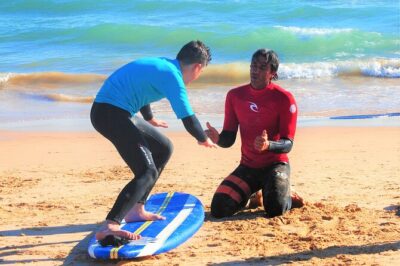
The key skill is getting from your stomach to your feet in one quick movement. The instructor first shows you how to push yourself up from the board, then helps you find a stable surfing stance.
This beach practice may feel repetitive, but it is where much of the useful work happens. You learn where your hands go, which foot leads, how to keep your knees bent, and how to face your body toward the side rather than standing rigidly forward. The board remains still, so you can concentrate on the sequence before adding moving water.
You should pay attention to the instructor’s corrections here. A beginner often wants to look down at the board while standing. You will have a better chance of balancing if you keep your body loose and follow the position you have just practised. The class is not a race, and watching someone else stand up does not mean you are falling behind.
The instructors appear to adjust the lesson according to ability. In one group, people with previous experience worked with one instructor while three beginners received focused help from another. That arrangement is especially useful if you arrive with friends who have different skill levels.
Same base, a different kind of day out:
- Cascais: Sunset Boat Trip with Welcome Drinks
★ 4.6 · 188 reviews - Cascais: Dolphin Watching Speedboat Tour
★ 4.9 · 156 reviews - Surf Lesson
★ 5.0 · 99 reviews - Cascais Deep-Sea Fishing Trip
★ 4.9 · 94 reviews
Moving into the Atlantic
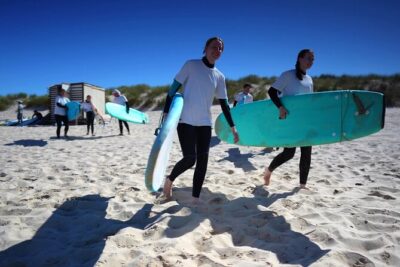
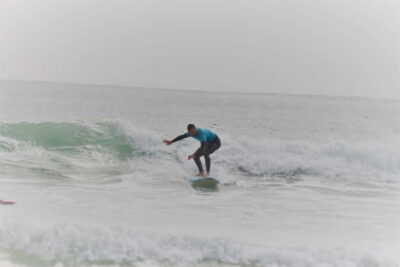
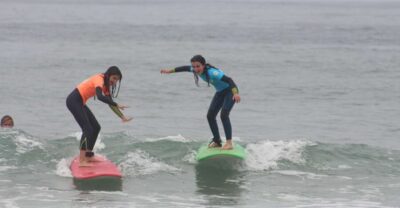
Once you understand the basic movement, the class heads into the water. This is where the lesson becomes much more physical and much more fun. You will carry or handle the board, wait for a suitable wave, paddle or position yourself as instructed, and attempt to stand at the right moment.
Your instructor remains nearby to offer tips and help you choose a manageable wave. The small-group limit matters here. Ten people is still a group, but it is far better than a crowded mass lesson where you spend most of the time waiting. If fewer people book your session, you may receive much more individual attention. One small class had only three participants, allowing the instructor to work closely with each person.
Do not expect every attempt to work. Falling is part of the lesson, and even standing briefly counts as progress. I like that the instruction aims at success without making the session feel like a test. The best result for a first lesson may be a single clean stand-up, a better understanding of the pop-up, or simply feeling calm enough to try again after a fall.
The water section also explains why the tide-based schedule matters. The school chooses the hour according to conditions, not just convenience. Your final time may differ from the time you expected when booking, so keep the day flexible.
Shaded loungers and a sensible pace

Surfing takes energy, especially when you are new to it. Between attempts, you can use shaded sun loungers to rest before returning to the water. This is a useful touch for a beach lesson, since it gives you somewhere to recover rather than forcing you to stand in the sun for the full session.
The break also lets you reset your technique. If your legs feel tired, a short pause can help you listen to the next instruction instead of repeating the same mistake. You should use the rest time sensibly, though. Two hours goes quickly, and the most valuable part of the class is the guided practice in the water.
The experience includes insurance, but that should not make you careless. Listen to the safety briefing, follow the instructor’s directions, and tell the staff if you feel uncomfortable or exhausted. Most people can participate, and service animals are allowed, but the activity still involves physical effort and ocean conditions.
What the $48.27 price includes

At $48.27 per person, the lesson offers solid value for someone who wants a proper first try without buying or renting gear separately. The price covers the professional guide, surfboard, wetsuit, insurance, and roughly two hours of instruction.
That is more useful than a simple board rental. A rental gives you equipment, but it does not teach you how to lie on the board, when to stand, or how to handle the first wave. Here, you get land practice, safety instruction, and help in the water.
The value depends on your goal. If you only want to stand on a board for a photograph, this may be more time and effort than you need. If you want to understand the basics and see whether surfing suits you, the price is reasonable. It also works well for couples, families with older children, and small groups of friends who want an active morning or afternoon near Lisbon.
The equipment is a real saving for anyone travelling light. You do not need to pack a wetsuit or arrange separate board hire. Food and drinks are extra, so bring your own water and plan around the two-hour class.
Who will enjoy this lesson most
This class suits first-timers who want clear instruction and a supportive introduction. It also works for mixed groups, since the school may divide people by ability. A 14-year-old and a 16-year-old both enjoyed a session, and an adult learning at age 40 found the experience reassuring and welcoming.
You do not need to be young, athletic, or already confident in the sea to take part. You do need to be comfortable with a physical activity that involves kneeling, pushing up, balancing, falling, and repeating the movement. The school says most people can participate, but the conditions can still be tiring.
I would be more cautious if you have a very fixed schedule. The lesson time is confirmed the day before because of tide restrictions. If you are flying, catching a train, or meeting a guide immediately afterward, the change may cause trouble.
The lesson is also not ideal if you expect a private instructor for your own party. The group maximum is 10, and the actual level of personal attention depends on the number of bookings and the mix of abilities. Still, the instructors appear willing to give extra help when beginners need it.
How to plan the day around the tide
The school sends a message the day before confirming the start hour. Keep your phone available and check messages before the lesson day. Do not assume that selecting a listed time means you have secured that exact hour.
This timing system is inconvenient, but it serves a purpose. Surfing depends on the tide and sea conditions, so a fixed clock time may not produce the best lesson. The trade-off is flexibility: you give up some control over your schedule in exchange for a better chance of usable conditions.
Weather can also cancel the activity. If poor weather makes the lesson unsafe, you can choose another date or receive a full refund. You can cancel for any reason up to 24 hours before the start time for a full refund. Cancellations or changes made inside that 24-hour window are not accepted, and the cut-off uses local time.
I would save the confirmation message and the school’s contact details. That makes it easier to confirm the meeting point and the final hour, especially if you are arriving from Lisbon and do not know the beach.
My practical verdict
I would book this lesson if you want a reasonably priced first taste of surfing close to Lisbon. The strongest points are the small maximum group, included equipment, patient instruction, and the chance to practise both on the sand and in the Atlantic. The instructors, including Pedro and another instructor named Pedro in one session, seem focused on helping beginners feel safe enough to keep trying.
I would not book it as a rigidly timed activity. The tide may move your lesson hour, and the broad beach address can slow you down if you arrive at the last minute. Give yourself extra time, bring water, keep the rest of the day flexible, and expect the waves to determine how much progress you make.
If you accept those limits, this is a useful, friendly introduction to surfing. You may stand up several times, or you may spend the class learning why standing up is harder than it looks. Either way, you leave with the basic technique, a taste of the Atlantic, and a fair idea of whether you want to try again.
FAQ
How long is the surf lesson?
The lesson lasts approximately two hours, including the safety briefing, warm-up, beach instruction, and time in the water.
Where does the lesson start and finish?
It starts at Carcavelos Surf School on Avenida Marginal by Praia de Carcavelos in Carcavelos, Portugal. The activity ends back at the same meeting point.
Are the surfboard and wetsuit included?
Yes. A surfboard and wetsuit are provided at no extra charge. Professional instruction and insurance are also included.
Is the lesson suitable for complete beginners?
Yes. The class teaches basic techniques such as pushing up from the board, finding balance, and setting your surfing stance before you enter the water.
When will I know the exact lesson time?
Because of tide restrictions, the school sends a message the day before confirming the lesson hour.
What happens if bad weather cancels the lesson?
You can choose an alternative date or receive a full refund if poor weather causes the school to cancel the activity.
Just added in Cascais
- Relaxed E-bike in the backroads of Cascais and Sintra★ 5.0 · 62 reviews
- Surf Lesson★ 5.0 · 99 reviews
- Cascais: Glamour and Decay by The Lisbon Coastline – Private Tour★ 5.0 · 44 reviews
- Open-Water Swimming in Cascais★ 5.0 · 72 reviews
- Cascais Private Sailing 2h Cruise with a drink★ 5.0 · 48 reviews
- Beginners, intermediate and advanced surf lessons★ 5.0 · 64 reviews
- Lisbon: Surf Lesson★ 4.5 · 110 reviews
- Lisbon: E-bike Trip from the Sintra Mountains to Cascais Sea★ 5.0 · 67 reviews
Surf Lessons, compared.
Beginner Surf Lesson at the Beautiful Algarvian West Coast
Read our review →
Browse the lists this tour appears in