
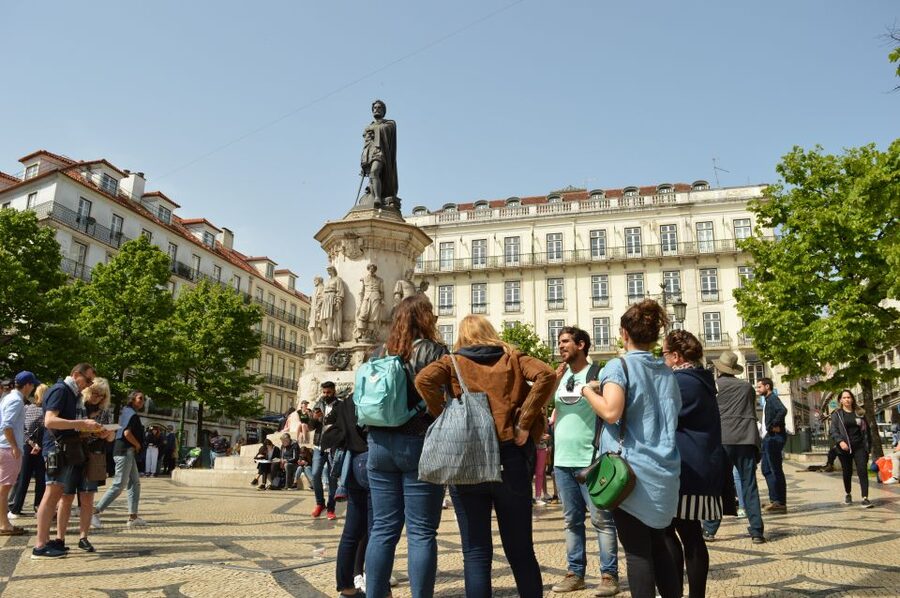
Reviewed · WALKING TOURS
Lisbon: Starter Walking Tour to the highlights in German
Lisbon reveals itself quickly on this two-hour German walking tour, which links grand squares, tiled façades, steep lanes, and famous landmarks without wasting time. You move from Rossio through Baixa, Chiado, and Bica, finishing near the Tagus at Time Out Market.
I like the small group limit of 12, which gives you a better chance to ask questions, and I like the mix of history and present-day Lisbon life. The guide does more than point at monuments, offering tips on food and places to explore. The main drawback is the pace: two hours is efficient, but you will not have time for long stops or full visits inside every sight.
Key points at a glance
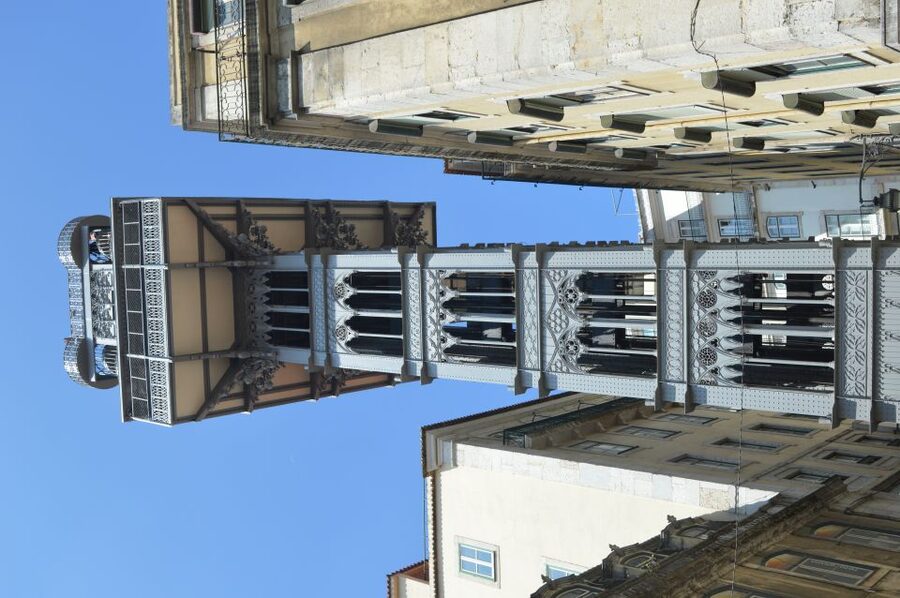
- German-language guidance: The tour is led in German, with guides such as Pedro offering clear explanations and time for questions.
- A smart first look at Lisbon: The route covers Rossio, Baixa, Chiado, Bica, Carmo, and the Santa Justa Lift before ending at Time Out Market.
- Small groups: Shared tours are limited to 12 people, with a private option available for your own group.
- Strong mix of old and new: You see convent ruins, Art Nouveau details, azulejos, a historic lift, a funicular, and a modern food hall.
- Useful local advice: Expect information about Lisbon today, including suggestions for eating and exploring after the walk.
- Be ready for hills: Comfortable shoes, water, and sunscreen matter. You need to manage stairs and sloping streets.
Start at Rossio Square, Lisbon’s natural meeting point
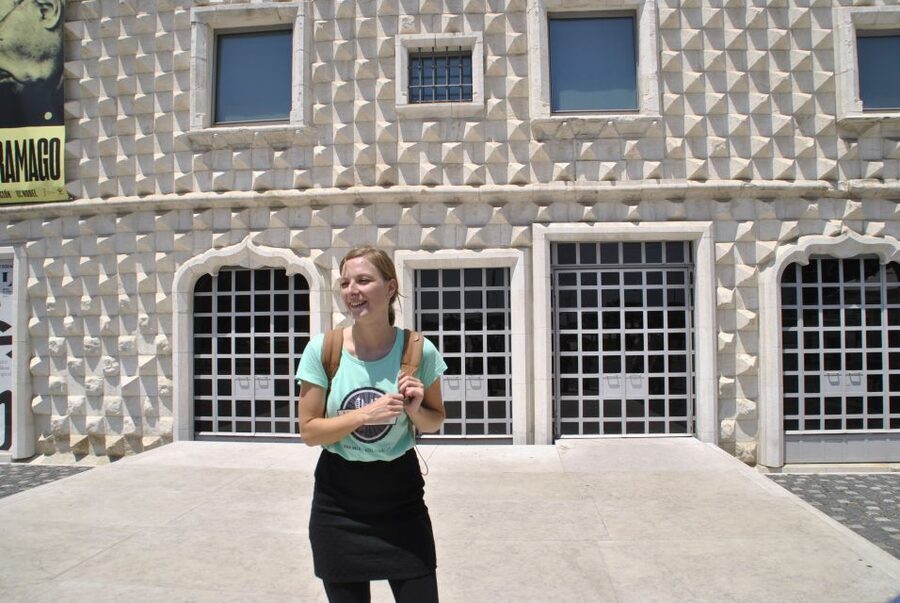
Your walk begins at Rossio Square, also called Praça Dom Pedro IV, by the northern fountain between the National Theater and the Royal Statue. This is a practical place to meet because it sits at the center of Lisbon’s historic core, but it can be busy and visually crowded.
Look for a guide wearing a mint-colored WALK ‘N’ ROLL T-shirt or carrying a matching mint-colored burlap bag. That detail matters in a large square where several tour groups may gather. Arrive with your meeting point details ready, and keep your eyes on the northern fountain rather than wandering toward the center of the plaza.
Rossio is a fine opening scene. Its patterned pavement and broad proportions give you an immediate sense of Lisbon’s public life. From here, you begin walking through Baixa, the orderly central district rebuilt after the 1755 earthquake.
The guide’s role here is not only to name buildings. You can expect context about how the city changed, how residents use these streets today, and how Lisbon’s past still shapes daily life. Recent guide feedback highlights Pedro as friendly, clear, and open to questions, so you may find a similar conversational approach depending on who leads your tour.
Other guided walks in Lisbon:
- Lisbon: History, Stories and Lifestyle Walking Tour
★ 4.8 · 10,902 reviews - Best of Lisbon Small-Group Guided Walking Tour
★ 5.0 · 4,869 reviews - Lisbon: Food and Wine Small Group Walking Tour
★ 4.9 · 4,082 reviews
Baixa and Rossio: Lisbon rebuilt on a grand plan
Baixa feels different from Lisbon’s older, more irregular hills. Streets are broad and relatively straight, with plazas and formal façades creating a strong contrast to the narrow lanes you will see later in Bica and Chiado.
This section helps you understand the city’s structure. Instead of treating Lisbon as a collection of pretty viewpoints, the walk shows how the central district works as a connected urban space. Your guide can also explain the relationship between the monumental streets, shops, cafés, and everyday city movement.
The advantage of seeing Baixa early in your visit is orientation. You learn where the central districts fit together, which makes it easier to return later. The limitation is that a walking tour can only provide an outside look at many buildings. If you want detailed interior visits, you will need to return on your own.
The tour also points out decorative details that are easy to miss when you are focused on crossing a street or climbing a hill. Lisbon’s azulejos, the painted ceramic wall tiles used across Portugal, appear on façades and interiors throughout the city. They are not just decoration. They help explain the local visual character and the way Portuguese architecture combines practical surfaces with careful design.
Santa Justa Lift and the Carmo Convent ruins
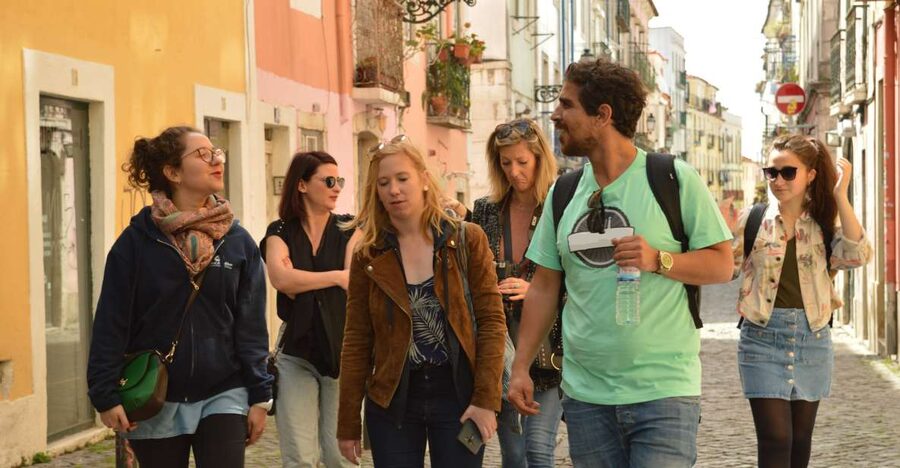
The Santa Justa Lift is one of Lisbon’s most recognizable structures. Its vertical iron frame rises above the surrounding streets, and its presence makes more sense when you see how sharply the city changes in height from Baixa toward Chiado.
On this tour, you receive a guided look at the lift and its place in Lisbon’s street system. Do not assume the two-hour walk includes a ride or a long wait in line. The experience is built around walking and explanation, so you should plan a separate visit if riding the lift is high on your list.
Nearby, the Carmo Convent ruins provide one of the most striking historic scenes on the route. The roofless Gothic structure offers a direct visual link to Lisbon’s earthquake history. Instead of hearing about destruction only as an abstract date, you see the open arches and surviving stonework for yourself.
This is one of the strongest stops for travelers who want history with a clear physical setting. It also has a practical limit: the tour does not function as a full museum visit. You get the story and the exterior atmosphere, then continue. If the ruins capture your attention, make a note to return with more time.
Chiado and Praça Luís de Camões
From the central districts, the route continues into Chiado. This area brings a different tone, with more artistic and literary associations, elegant façades, tiled surfaces, and a busy connection between Baixa and the higher streets.
Your guide uses Chiado to connect architectural details with city life. Look for Art Nouveau touches and azulejos as you walk, but also pay attention to how people use the streets. The point is not simply to collect landmark photographs. You begin to see how Lisbon’s historic center remains part of ordinary life.
Praça Luís de Camões is a useful pause in the route. The square links Chiado with Bica and provides a clear sense of how Lisbon’s central neighborhoods meet. It is also a good place to listen, since the open space gives your guide room to explain the next part of the walk.
I like this middle section because it balances famous sights with smaller visual details. You may not leave knowing every building’s name, but you should become better at reading Lisbon’s streets. That is valuable for the rest of your stay, especially when you are choosing where to wander without a guide.
Same base, a different kind of day out:
- Lisbon City Center Tour – The Unmissable Lisbon
★ 5.0 · 22,234 reviews - Lisbon: Sintra, Pena, Regaleira, Cabo da Roca & Cascais
★ 4.7 · 19,656 reviews - Lisbon: Jerónimos Monastery Entrance Ticket
★ 4.1 · 14,164 reviews - Lisbon: Sunset Boat Party Cruise with DJ and Open Bar
★ 4.5 · 10,378 reviews
Bica and the famous yellow funicular
The walk then reaches the Elevador da Bica, the cable car or funicular that climbs one of Lisbon’s steep streets. It is a classic city image, but the setting explains its importance better than a photograph does. The incline is a reminder that Lisbon is not a flat sightseeing city.
The tour focuses on the funicular and the surrounding street rather than promising a ride. You can admire the route, understand how it connects the lower and upper parts of the neighborhood, and decide later if you want to return to use it.
This is also where the physical demands of the tour become more obvious. You will walk on slopes and climb some stairs. The experience is not suitable for wheelchair users or people with mobility impairments, and a moderate level of fitness is required.
Wear shoes with a solid grip. Bring water and sunscreen, especially if you are visiting in warm weather. Lisbon’s pavement can be hard on your feet, and the route includes enough uneven or sloping ground that flimsy footwear is a poor choice.
Views, azulejos, and the character of Lisbon
Along the way, the guide takes you to a special viewpoint and points out the city’s changing elevations. The exact view can depend on the route and conditions, but the purpose is clear: you get a broader sense of Lisbon rather than seeing each neighborhood as a separate stop.
The city’s tiled buildings are another recurring theme. Azulejos can turn an ordinary wall into something worth stopping for, and they give the streets a visual rhythm that differs from many other European capitals. You will also see Art Nouveau architecture, adding another layer to the route.
This is where a local guide adds real value. A short walk cannot explain every tile pattern or façade, but it can teach you what to notice. You may leave more alert to small details, from wall surfaces to street grades, instead of rushing only toward the best-known monuments.
The guide also discusses Portuguese culture, current events, and what life in Lisbon is really like. That part makes the experience more useful than a landmark checklist. If you are curious about how residents experience the city, ask questions as you walk. The tour is designed to leave room for that kind of conversation.
Finish at Mercado da Ribeira and Time Out Market
The final stop is Mercado da Ribeira, now widely known as Time Out Market Lisboa, near the Tagus River. This gives the route a satisfying change of mood. You begin with formal squares and major monuments, then finish in a modern market hall built around food and social life.
Food and drinks are not included, so plan on paying separately if you eat there. Still, ending at the market is useful. You can continue exploring after the tour, have a meal, or use the location as a starting point for the rest of your day.
The guide’s restaurant and sightseeing tips may be especially helpful here. Ask for advice before saying goodbye, since the tour is meant to help you plan the rest of your stay. You may also want to note that the finish is not the same as the starting point, so keep your afternoon plans flexible.
What $33 buys you in two hours
At $33 per person, this is priced as an orientation walk rather than a full-day cultural tour. You are paying for a live German-speaking guide, a compact route through several key districts, and practical context that would take time to assemble alone.
The value is strongest if you have just arrived in Lisbon. In two hours, you get a city framework: Rossio and Baixa for the central grid, Chiado for the higher urban district, Bica for the steep streets, and the market near the river for a modern finish.
The price is less compelling if you already know central Lisbon well or prefer to spend long periods inside monuments. The route moves at a steady pace, and food, drinks, transport, admission fees, and hotel pickup are not included.
A shared group is capped at 12 people, which is a sensible size for a walking tour. You should have a better chance to hear the guide and ask questions than in a large coach-style group. If you want a slower pace or a tour designed only for your party, a private option is available.
Who will get the most from this walk?
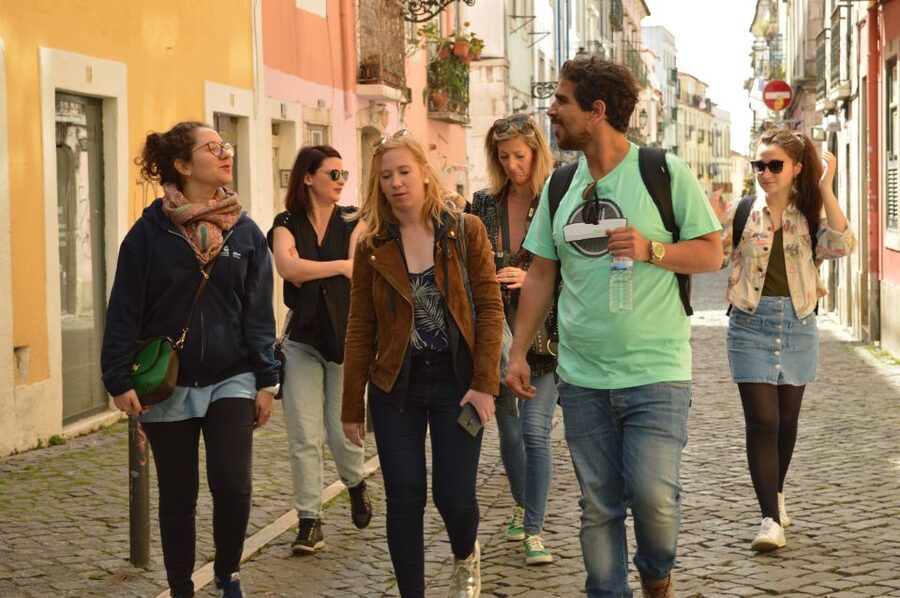
This tour suits you best if German is your preferred tour language and you want a clear introduction to Lisbon’s historic center. It is also a strong fit for first-time visitors who want practical ideas for the rest of their stay.
You will benefit most if you enjoy a mix of famous sights and local explanation. The route does not focus only on postcard landmarks. It brings in architecture, tiles, city history, current life, and food suggestions.
The walk is less suitable if you have limited mobility, dislike hills, or want a relaxed stop-and-stare pace. It is also not designed for baby strollers or luggage and large bags. Rain may change the final 30 minutes of the route because Lisbon’s slopes can become slippery.
Recent German-language feedback gives the tour a 4.9 rating from 781 reviews, with repeated praise for the small group, the amount covered in two hours, and the balance of history and present-day information. That matches the experience’s main strength: it gives you a useful first map of Lisbon without taking up half a day.
You can cancel up to 24 hours before the start for a full refund, and the reserve-now, pay-later option keeps your plans flexible. Check the available start times when booking, since the two-hour duration does not by itself specify a single daily departure.
Should you book the Lisbon German walking tour?
Book it if you want a fast, well-organized introduction to central Lisbon in German, especially at the start of your visit. The route covers enough ground to orient you, while the small group and local questions make it more personal than simply following a map.
Skip it if your priority is riding the Santa Justa Lift, entering every historic building, or spending a long time at one viewpoint. For most people, the best use is as a first-day walk, followed by independent visits to the places that catch your interest.
FAQ
How long is the walking tour?
The tour lasts two hours.
What language is the tour conducted in?
The live tour guide speaks German.
Where does the tour begin?
It begins at Rossio Square, also called Praça Dom Pedro IV, by the northern fountain between the National Theater and the Royal Statue.
How do I identify the guide?
The guide will either wear a mint-colored WALK ‘N’ ROLL T-shirt or carry a mint-colored WALK ‘N’ ROLL burlap bag.
Where does the tour finish?
The tour finishes at Time Out Market Lisboa, also known as Mercado da Ribeira, near the Tagus River.
What sights are included on the route?
The route includes Baixa, Rossio Square, the Santa Justa Lift, Carmo Convent, Chiado, Praça Luís de Camões, the Elevador da Bica, and Mercado da Ribeira.
Is food included?
No. Food and drinks are not included.
Is the tour suitable for wheelchair users?
No. The tour is not suitable for wheelchair users or people with mobility impairments. You must be able to walk for the full two hours and climb a few stairs.
What should I bring?
Bring comfortable shoes, sunscreen, and water. Baby strollers, luggage, and large bags are not allowed.
Just added in Lisbon
- From Lisbon: Horseback Riding on Comporta Beach★ 4.7 · 167 reviews
- Lisbon: City Highlights Segway Tour★ 4.9 · 422 reviews
- Lisbon: Street Art Tuk Tuk Tour★ 4.9 · 372 reviews
- Lisbon: Segway Medieval Tour of Alfama and Mouraria★ 4.9 · 420 reviews
- LISBON Street Art Tour★ 5.0 · 371 reviews
- Évora and Monsaraz with Regional Wine Tasting from Lisbon★ 4.5 · 229 reviews
- Évora and Megaliths Full-Day Tour from Lisbon★ 4.7 · 456 reviews
- Arrabida and Sesimbra Small-Group Day Trip from Lisbon with Wine Tasting★ 5.0 · 494 reviews
Walking Tours, compared.
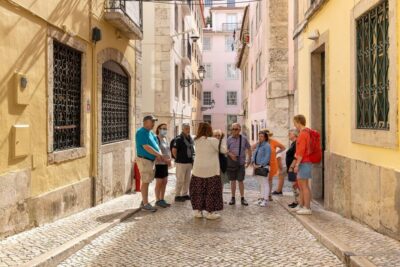

Best of Lisbon Small-Group Guided Walking Tour
Read our review →
Porto Walking Tour, Lello Bookshop, River Cruise and Cable Car
Read our review →

Best of Lisbon Walking Tour: Rossio, Chiado & Alfama
Read our review →
Experience Porto’s Charm: 3-Hour Guided Walking Tour
Read our review →
Browse the lists this tour appears in