
Reviewed · TOURS IN LISBON
Lisbon Hidden Gems Walk: Traditions, Lunch and Ferry ride
Lisbon’s best introduction may be the one that gets you away from its big-name sights and into Mouraria, where narrow lanes, small churches, old shops, and many cultures tell a more personal story of the city. This four-hour walk adds the pleasures that make Lisbon easy to love: coffee and pastry, a cold beer, a ferry ride, and seafood rice across the river.
I like the small group of no more than 14, which gives guides such as Maria, Carlos, Filipe, Martin, and Daniel room to answer questions and adjust the pace. I also like the mix of history and ordinary life, from Fado and Maria Severa to a local bakery and the ferry used to reach Cacilhas.
The main concern is food. Traditional venues may not handle special diets well, and vegan, celiac, Kosher, and Halal options are not available. You should also expect a fair amount of walking, cobblestones, stairs, and some uneven ground.
Key points to know before booking
- Mouraria comes first: Begin in Martim Moniz and explore a part of Lisbon that many sightseeing routes skip.
- Four tastes of Portugal: The tour includes coffee and pastel de nata, beer, green wine, bread, and seafood rice.
- Fado gets personal: Hear about Maria Severa and the roots of Portugal’s famous song tradition.
- The ferry is part of the sightseeing: Cross the Tagus to Cacilhas for wide views back toward Lisbon.
- A useful first-day choice: Guides offer practical tips for the rest of your stay, including restaurant and Fado suggestions.
- Food restrictions matter: Vegetarian and gluten-free alternatives may be possible, but they are not guaranteed.
Why this four-hour route works so well
This is not a monument checklist. You will not spend the morning standing in line for the Santa Justa Lift or touring the inside of a grand church. Instead, the route links small details, local food, city views, and a short trip on public transport.
That makes the tour especially useful at the beginning of a Lisbon stay. You get your bearings in the historic center, learn how several neighborhoods fit together, and collect ideas for later. Guides have pointed people toward dinner, Fado music, and places to see beyond the usual center.
The price is $48.39 per person. For that amount, you receive a local guide, coffee and pastry, beer, the ferry ride, and lunch with seafood rice, bread, and green wine. I consider that good value if you want food and transport included rather than paying separately for a basic walking tour and finding lunch afterward.
Still, this is not the right pick if you want a quiet museum visit or a purely historical walk. The experience is social and food-led. It works best for someone happy to walk, stop often, eat what is served, and learn through conversation.
A few more things to do in Lisbon worth a look
- Lisbon: Portuguese Wine and Cheese Tasting with Lunch
★ 4.7 · 353 reviews - From Lisbon: Arrábida Natural Park Kayak Tour with Lunch
★ 4.8 · 320 reviews - SINTRA Day Trip – Tickets & Lunch Included
★ 5.0 · 44 reviews
Starting in Martim Moniz and entering Mouraria
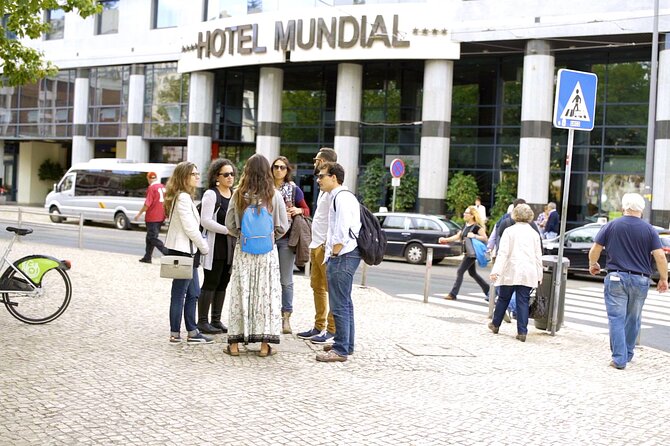
Meet at Praça Martim Moniz at 10:00 a.m. The square sits in one of Lisbon’s most multicultural areas, with food from many parts of the world, shops, music, and weekend market activity.
From here, the route turns into Mouraria. The name points to the area’s long connection with Lisbon’s Moorish past, but the neighborhood’s story reaches far beyond one period. Portugal’s maritime links brought people and influences from many places, and Mouraria became a meeting point for different communities.
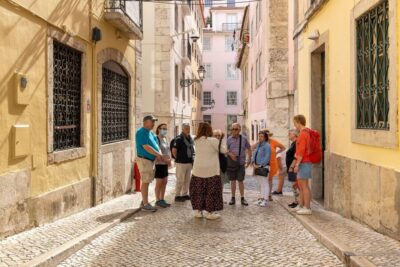
You will walk narrow streets where cars cannot easily go. That is one of the route’s strengths. Instead of seeing Lisbon through a coach window, you notice the small scale of the old quarter: tiled walls, traditional stores, modest churches, and daily life unfolding close to the pavement.
Do not expect a polished district at every turn. Mouraria can feel worn and crowded in places, and the streets are not always easy underfoot. That is part of the point. This is a working historic neighborhood, not a stage set prepared for sightseeing.
The walking time here is listed at about 20 minutes, with a short introduction in Martim Moniz. In practice, the guide’s storytelling and food stops shape the pace more than the clock. Guides such as Daniel and Leslie have been especially good at adding local recommendations and talking about present-day Portugal alongside older events.
Fado, Maria Severa, and the sound of Lisbon
The Fado portion gives the walk a human center. Fado is Portugal’s best-known musical tradition, and it is recognized by UNESCO as Intangible Cultural Heritage. In Mouraria, the guide explains the story of Maria Severa, an important early figure in Fado’s history.
This is more useful than simply being told that Fado is sad Portuguese music. You get a sense of how music, neighborhoods, and working lives were linked. The story helps explain why Fado belongs to Lisbon’s streets and taverns, not only to formal concert venues.
If you plan to attend a Fado performance later, pay attention here. The guide may help you choose a suitable place, and several guides have offered suggestions for evening plans. This is one reason I would schedule the tour near the start of your visit rather than on your final morning.
Coffee, pastel de nata, and a bakery away from the crowds

A bakery stop adds a welcome pause. You receive a traditional pastel de nata with hot coffee, while the guide continues the story of Lisbon and you have a chance to interact with locals.
The pastry is not just a snack inserted into the schedule. It shows how food fits into the city’s daily rhythm. Coffee and a small pastry are a normal Lisbon break, and the stop gives you a better feel for that habit than a quick pastry bought from a large tourist café.
The exact bakery is described as being away from the main tourist crowds. That sounds appealing, but remember that the tour visits traditional places where alternatives can be hard to arrange. If you have a serious allergy, ask before booking and do not assume that a substitution will be possible.
Same base, a different kind of day out:
- Lisbon City Center Tour – The Unmissable Lisbon
★ 5.0 · 22,234 reviews - Lisbon: Sintra, Pena, Regaleira, Cabo da Roca & Cascais
★ 4.7 · 19,656 reviews - Lisbon: Jerónimos Monastery Entrance Ticket
★ 4.1 · 14,164 reviews - Lisbon: History, Stories and Lifestyle Walking Tour
★ 4.8 · 10,902 reviews
Rossio Square, the train station, and Lisbon’s pavement
The route continues toward Rossio, passing the neo-Manueline façade of Rossio train station. This ornate frontage is one of central Lisbon’s most recognizable pieces of architecture, and it gives the walk a change of mood after the tight lanes of Mouraria.
At Praça Dom Pedro IV, usually called Rossio, the guide explains the famous Portuguese cobblestone paving. The square has served as a meeting place since the Middle Ages and has seen celebrations, revolts, bullfights, and executions.
You have only about five minutes listed for the square, so this is not a long stop for photographs or independent wandering. The value comes from the explanation and from seeing how the square connects the older neighborhoods to Pombaline Baixa.
The wider route also touches Chiado, Lisbon’s cultural and shopping district. Its theaters, museums, historic buildings, and shops make it a useful contrast to Mouraria. The walk does not promise guided visits inside monuments, so you should treat these places as exterior sights and context, not as an architectural tour.
Carmo Convent and the beer stop

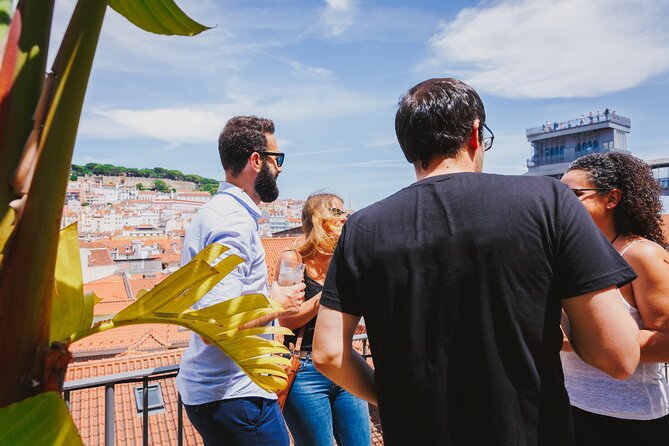
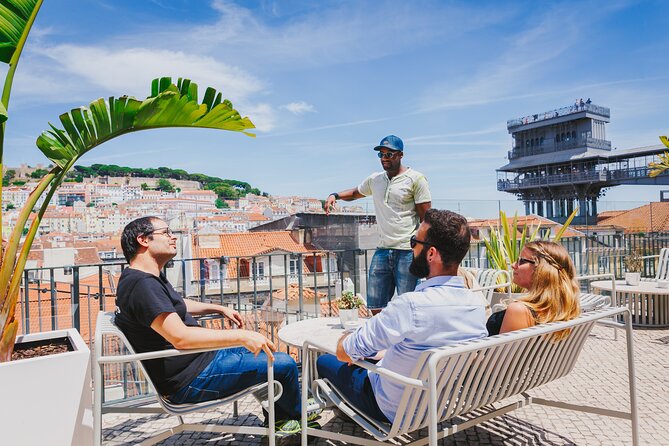
The next notable point is Carmo Convent. From here, you can see São Jorge Castle and the Santa Justa Lift, along with broad views over central Lisbon. The stop includes a Portuguese beer, which turns sightseeing into a proper rest rather than another hurried photo break.
This is one of the tour’s most praised features: a good balance between walking, history, food, and time to sit. Guides have used the beer stop to discuss the Carnation Revolution, Portugal’s peaceful 1974 shift away from dictatorship. That gives a major national event a setting you can actually remember.
The Santa Justa Lift is seen but not ridden. The tour does not include a trip on it, so do not book this experience expecting an included lift ticket. You will still get the view and the guide’s explanation without waiting in the lift queue.
The streets around Carmo can include stairs and sloping pavement. One guide, Daniel, was noted for being patient with people who had trouble on steps and climbs, but you should still have moderate fitness and wear solid shoes.
Crossing the Tagus to Cacilhas
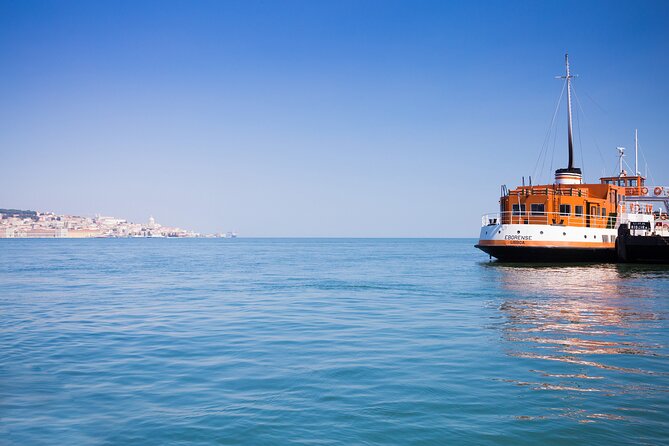
After central Lisbon, the route heads toward the Tagus. The river has a large place in Portuguese songs and poems, and the ferry ride gives you a different view of the city than you get from its streets.
The crossing to Cacilhas takes about 15 minutes. It is not a private cruise or a long sightseeing boat trip. It is a regular ferry ride, which is exactly why I like it. You are using a practical part of Lisbon’s transport network while gaining a wide view back toward the city.
Have your camera ready as the boat leaves the riverbank. You can see Lisbon from the water, with the hills and historic center rising behind the waterfront. The change in angle helps you understand the city’s shape in a way that another square or viewpoint cannot.
The ferry ride also breaks up the walking. By this stage, a seat and a breeze are welcome. You finish the crossing at Cacilhas, on the south side of the Tagus.
Seafood rice and green wine in Cacilhas
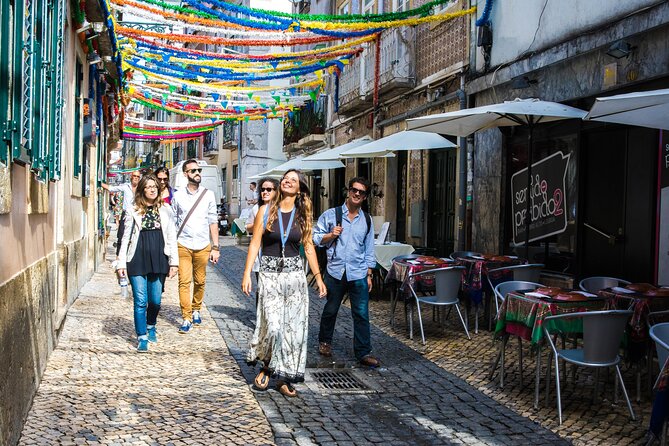
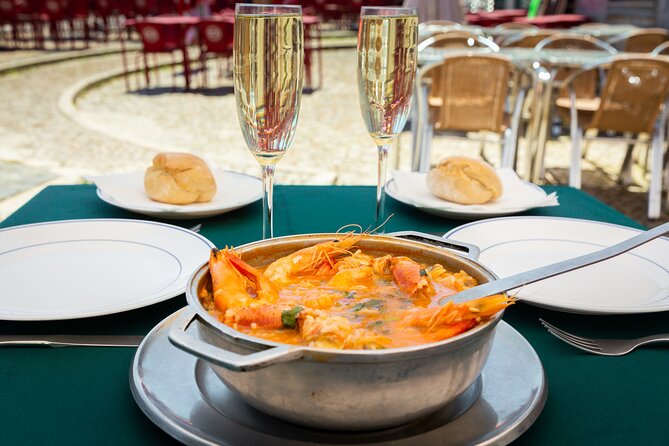
Cacilhas is presented as a small riverside village with many seafood restaurants. The lunch stop includes seafood rice, bread, and green wine. Some descriptions of the meal mention a generous serving shared by two people, though portions and presentation can vary.
This is the meal that makes the tour more than a snack walk. Seafood rice is comforting rather than fussy, and it suits the setting: a simple dish eaten near the river with Lisbon spread out across the water.
Green wine, or vinho verde, comes with lunch. It is a Portuguese wine style known for its fresh character, and it works well with seafood. You do not need to be a wine expert to enjoy this part. The point is to try familiar local food and drink in an ordinary restaurant setting.
Food quality is a strong reason to book, but the limitations need to be clear. Vegetarian and gluten-free options may be available, but they are not guaranteed at every stop. The experience is not suitable for vegans, people with celiac disease, or those requiring Kosher or Halal food. Pregnant guests and anyone with a food allergy should contact the provider before booking and should be prepared for limited alternatives.
After lunch, the tour returns toward central Lisbon. The end point is Cais do Sodré, a major transport area with ferry, train, and metro connections. The Pink Street nightlife area is nearby, though it is not presented as a formal stop.
Group size, guides, and the walking pace
The group has a maximum of 14 people. That is small enough for a guide to hear questions and keep everyone together, but it is not a private tour. Your experience will depend partly on the day’s group and the guide assigned.
The guides named in the tour feedback include Maria, Franco, Carlos, Filipe, Guilherme, Daniel, Natália, Chon, Martin, Alex, Philla, Leslie, Filipa, and Johnny. The repeated strengths are friendly conversation, strong English, useful local advice, and clear explanations of Portuguese history.
The pace is described as leisurely and well managed, but you will still walk through hilly streets and over cobblestones. Wear comfortable shoes with a good grip. This is not a good match for anyone looking for a vehicle-based tour or a route with no stairs.
The tour is offered in English and uses a mobile ticket. Service animals are allowed, and the route is near public transport. The start is at Praça Martim Moniz, and the finish at Cais do Sodré makes it easy to continue exploring or return to your accommodation.
Who should book this Lisbon experience
I would choose this tour for a first or second day in Lisbon. It gives you orientation, a neighborhood walk, a view from the river, and several foods to try. It also leaves you with practical ideas for the rest of the trip.
It suits couples, solo visitors, and small groups who like to ask questions and share a meal with other people. The format is also good for anyone who wants more than monuments but does not want to plan every stop independently.
I would hesitate if you have strict dietary needs, limited walking ability, or a strong preference for museums and formal sites. You may also prefer another tour if you want extensive time at each attraction, since the route covers several areas in four hours.
Cancellation is free up to 24 hours before the 10:00 a.m. start. Changes or cancellations inside that window are not accepted for a refund, and the activity requires a minimum number of participants.
Should you book this tour?
Book it if you want a well-paced introduction to Lisbon through neighborhoods, food, and public transport. The Mouraria walk and Fado story give the morning character, while the ferry and Cacilhas lunch keep it from feeling like a standard city-center circuit.
At $48.39, the included food, drinks, ferry, and guide make the cost fair. Just arrive in walking shoes, bring an appetite, and be honest about your dietary needs before paying. If those conditions suit you, this is a smart way to get your bearings and start seeing Lisbon as a lived-in city rather than a collection of postcard stops.
FAQ
Where does the Lisbon Hidden Gems Walk begin?
The tour begins at Praça Martim Moniz 2, 1100-341 Lisboa, Portugal.
What time does the tour start?
The scheduled start time is 10:00 a.m.
Where does the tour finish?
The tour ends at Cais do Sodré in Lisbon.
How long does the tour last?
The experience lasts approximately four hours.
How many people can join the tour?
The maximum group size is 14 travelers.
Is the tour offered in English?
Yes. English is the listed language for the tour.
What food and drinks are included?
The tour includes coffee and pastries, beer, seafood rice, bread, and green wine.
Is the ferry ride included?
Yes. A ferry ride across the Tagus to Cacilhas is included.
Does the tour include a ride on the Santa Justa Lift?
No. The tour does not include a trip on the Santa Justa Lift.
Can people with dietary restrictions join?
Vegetarian and gluten-free alternatives may be available but are not guaranteed. Vegan, celiac, Kosher, and Halal options are not available, and traditional venues may have difficulty accommodating allergies or other dietary requirements.
Just added in Lisbon
- Divine Fátima Full Day Private Tour from Lisbon★ 5.0 · 308 reviews
- Fátima Batalha Nazaré and Óbidos Private Tour★ 5.0 · 254 reviews
- Lisbon Fado Experience: Walking Tour, Dinner and Live Music Show★ 4.5 · 336 reviews
- Lisbon to Fatima/Batalha/Nazare & Obidos guided tour 8pax group★ 5.0 · 213 reviews
- Family Tour: Essential Lisbon★ 5.0 · 56 reviews
- From Lisbon: Fatima Batalha Nazare & Obidos Small Group Day Trip★ 4.5 · 533 reviews
- Faith and Heritage: Fátima, Batalha, Nazaré, Óbidos from Lisbon★ 4.5 · 108 reviews
- Lisbon Fado History Cultural Walking Tour★ 5.0 · 118 reviews
Tours in Lisbon, compared.
Lisbon City Center Tour – The Unmissable Lisbon
Read our review →
Sintra, Pena, Regaleira, Cabo da Roca & Cascais
Read our review →

Sunset Boat Party Cruise with DJ and Open Bar
Read our review →
Pena Palace, Sintra, Cabo da Roca, & Cascais Daytrip
Read our review →

True 4Hour Private Tuk Tuk Tour: Discover Lisbon with a Local!
Read our review →Browse the lists this tour appears in