

Reviewed · LISBON NEIGHBOURHOOD WALKS
Discover Bairro Alto’s Hidden Gems and Stunning Viewpoints
Lisbon’s hills make more sense when you walk from Rossio toward Bairro Alto, following the city’s story from royal railways and national poets to plague, faith, and earthquake damage. This tour gives you that useful framework without charging an admission fee at its main stops. Rossio Station and the ruins of Carmo are the real visual anchors.
I like the route’s gradual climb and its focus on places you can easily revisit on your own. I also like the guide’s emphasis on Portugal’s past, especially the 1755 earthquake and the changing role of Bairro Alto. The main consideration is cost: the advertised price is only $3.61, but you are expected to contribute €10 to €20 to the guide, and the walk requires moderate physical fitness.
Key points to know before you book

- Rossio to Bairro Alto: The route links central Lisbon’s main square with its upper neighborhood on foot.
- Rossio Station’s unusual façade: Look for the paired horseshoe entrances and Neo-Manueline decoration.
- Camões in the city center: Praça Luís de Camões introduces Portugal’s national poet and his epic poem Os Lusíadas.
- Bairro Alto’s changing purpose: You’ll hear how plague, population growth, churches, and urban planning shaped the district.
- Carmo’s dramatic past: Largo do Carmo connects a medieval religious foundation with Lisbon’s earthquake story.
- A contribution-based price: The booking price is low, but budget an additional €10 to €20 for the guide.
Why this walk helps you understand central Lisbon
I like this experience because it is less about checking off isolated sights and more about connecting them. You begin in Rossio, move through the lower center, climb toward Bairro Alto, and finish around the Carmo and Santa Catarina areas. That sequence mirrors Lisbon’s physical shape: a city of squares, slopes, churches, and viewpoints.
The walk lasts about two and a half hours. That is long enough for a proper introduction, but not so long that the route takes over your whole day. You can still use the afternoon or evening for another part of Lisbon, perhaps Belém or the riverfront, though this tour itself does not visit Belém.
The experience is offered in English and is led by a local guide. The group can include up to 50 people, so do not expect a private walk or a quiet conversation at every stop. A larger group may make it harder to hear in busy squares, but it also keeps the cost low and gives the guide a chance to address common questions about Lisbon.
Other quarters worth walking in Lisbon:
- Alfama Tour in Lisbon Old Town
★ 5.0 · 4,936 reviews - Private Lisbon Sightseeing Tuk-Tuk Tour: Alfama, Belém & More
★ 5.0 · 4,277 reviews - Lisbon: Hills, Alfama, and Mouraria Tour by Electric Bike
★ 4.8 · 3,438 reviews
Starting in Rossio at Praça Dom Pedro IV
The meeting point is Praça Dom Pedro IV, usually called Rossio, at 1100-581 Lisbon. This is a practical place to begin because it sits in the center of the city and is close to public transportation.
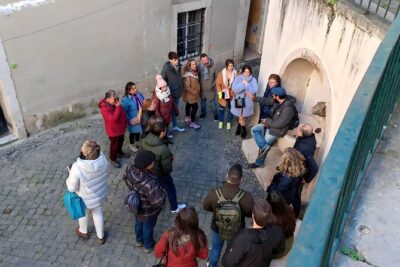
The first 25 minutes are used to set the scene. You are not simply crossing a square on the way to the next attraction. You are learning why Rossio has long been one of Lisbon’s key public spaces and how the city expanded from its older core.
I find this opening useful for first-time visitors because Lisbon can feel confusing at ground level. Streets change direction, hills appear without warning, and several neighborhoods overlap. Starting in a major square gives you a clear point on the map before the route heads uphill.
There is no admission fee at this stop. Expect an outdoor introduction rather than a formal museum visit. Bring water, wear shoes with a firm sole, and keep your belongings close in crowded areas. Those are sensible habits for any walk through central Lisbon.
Rossio Station and its theatrical Neo-Manueline entrance
Estação do Rossio receives about 25 minutes, and it deserves that time. The building was designed between 1886 and 1887 by Portuguese architect José Luís Monteiro for the Portuguese Royal Railway Company. It opened in 1890 and connected Lisbon with Sintra.
The station’s style is Neo-Manueline, a later Romantic recreation of the ornate Manueline style associated with early 16th-century Portugal. The building does not look like a plain transport facility. Its façade has a ceremonial, almost temple-like quality, which is part of its charm.
Your guide should point out the two intertwined horseshoe portals at the entrance. They are the feature most likely to catch your eye, especially with the words Central Station above them. This is a good example of how Portugal has often looked backward to important chapters of its past when designing modern public buildings.
I appreciate this stop because it rewards close looking. You do not need to enter a museum or pay an admission charge to see something distinctive. Take a moment to examine the stonework, the symmetry, and the contrast between the station’s grand exterior and its everyday purpose.
The station is still a functioning transport point, so the area can be busy. You may not get a long, uninterrupted explanation if trains, pedestrians, or traffic compete for attention. Still, it is one of the strongest architectural stops on the route.
Praça Luís de Camões and Portugal’s national poet
The next major stop is Praça Luís de Camões, with about 30 minutes devoted to Portugal’s national poet. Luís de Camões is best known for Os Lusíadas, the epic poem about Vasco da Gama’s sea route to India.
His importance goes beyond a monument in a square. The poem helped shape Portugal’s national story, and the Portuguese language is sometimes called the language of Camões. The tour also includes the traditional account that he lost one eye while fighting in Ceuta.
I like this part of the walk because it adds a human and literary layer to Lisbon. You are not only looking at churches, stations, and paved streets. You are hearing how one writer became tied so closely to the country’s identity.
The square also works as a transition point. From here, the route moves toward Bairro Alto, and your guide explains how this part of Lisbon once sat near the edge of the city. The physical climb becomes part of the story. You are walking into an area that developed as Lisbon grew beyond its older boundaries.
If you have little interest in poetry, this stop may feel slower than the architecture stops. Give it a fair chance, since the explanation helps place later sights in a wider Portuguese context.
Same base, a different kind of day out:
- Lisbon City Center Tour – The Unmissable Lisbon
★ 5.0 · 22,234 reviews - Lisbon: Sintra, Pena, Regaleira, Cabo da Roca & Cascais
★ 4.7 · 19,656 reviews - Lisbon: Jerónimos Monastery Entrance Ticket
★ 4.1 · 14,164 reviews - Lisbon: History, Stories and Lifestyle Walking Tour
★ 4.8 · 10,902 reviews
Bairro Alto, from city edge to crowded neighborhood
The Bairro Alto section lasts around 30 minutes and covers some of the most useful historical context on the route. In the late 15th century, Lisbon’s population included people arriving from many parts of the world, partly because of Portugal’s overseas expansion. The city needed more room, and the area around today’s Camões Square became one of the entrances into Lisbon.
The district’s early story is not polished or simple. A wall and the Santa Catarina gate once marked the city’s edge. Beyond the wall were lands linked to wealthy noble families, along with a cemetery for victims of the Black Death.
In 1506, King Manuel I requested a relic of Saint Roch from Venice. It was placed in a hermitage near the cemetery. As the population grew and plague affected Lisbon, poorer residents and sick people moved closer to the church. Urban planning followed, shaping the neighborhood that developed here.
This explanation gives you a better way to read Bairro Alto. Today, you may associate the district with evening activity and narrow streets, but its foundations were tied to public health, religious care, social class, and the need to house a growing population.
I value this section because it avoids treating the neighborhood as a collection of pretty lanes. You learn why people came here, who controlled the land, and how disease influenced the city’s growth. The subject matter can be sobering, but it is essential to understanding old Lisbon.
The walk is outdoors, and the route includes uphill streets. The description calls for moderate physical fitness, so this is not the best choice if you need a completely level route or have difficulty walking on slopes. The guide can explain the area, but the experience does not include private transportation.
Largo do Carmo and the story of the Carmelite convent
The route then reaches Largo do Carmo, where the Carmelite church and convent form one of Lisbon’s most memorable historic settings. The complex was founded after Nuno Álvares Pereira, a general serving King John, vowed to build the world’s most beautiful church if Portugal defeated Castilian forces at the Battle of Aljubarrota in 1385.
Portugal won, and Pereira kept his promise. Construction of the Carmelite church and convent began in 1389 and was completed in 1423. Pereira later joined the Carmelite order and spent the rest of his life in the convent.
The story combines military history, religious devotion, and personal commitment. It also gives you a reason to pay attention to the building beyond its appearance. You are looking at a place tied to a national victory and to one man’s decision to leave public life for religious service.
Largo do Carmo is also closely linked to the damage caused by Lisbon’s great earthquake. The tour includes the history of the earthquake and the destruction that followed, making this stop especially useful for understanding why parts of the city look so different from one another.
The supplied route describes Largo do Carmo as the final major historical stop, while the stated endpoint is Miradouro de Santa Catarina at 1200-262 Lisbon. Because meeting and ending details can vary in how they are presented, confirm the exact finishing point when you book. In either case, you should expect to finish somewhere in Lisbon’s upper central neighborhoods, not return to Rossio.
Entry to the Santa Justa Elevator is not included. The walk does not promise entry to the Carmelite ruins or any other paid attraction, so check the guide’s instructions if you want to visit an interior afterward.
What the low price really means
At $3.61 per person, the advertised booking price looks almost symbolic. That makes the experience attractive for anyone who wants a guided introduction without committing to an expensive private tour.
The important detail is the expected contribution of €10 to €20 for the guide. I would treat that amount as part of the real cost, not as an optional surprise. Even with the contribution, the price remains reasonable for two and a half hours with a local guide, especially when the major stops do not charge admission.
The value depends on what you want. If you mainly need directions and photographs, you can walk through Rossio and Bairro Alto without a paid tour. If you want the links between the railway station, Camões, plague, religious foundations, and earthquake damage explained as you go, the contribution can be worthwhile.
Discounts for other experiences in Lisbon are also offered for the rest of the day. The details of those discounts are not specified, so I would not include them in your budget until you know what applies.
Who will get the most from this experience
I would recommend this walk to a first-time visitor who wants a clear introduction to central Lisbon. It suits people who prefer history told on the street rather than in a long museum visit, and it gives you several neighborhoods to explore again later.
It is also a good fit if you want to understand Bairro Alto beyond its evening reputation. The guide’s focus on population growth, disease, religion, and city planning adds substance to an area that can otherwise seem like a maze of slopes and façades.
You may want a different experience if you prefer a private guide, a small group, or a carefully paced architecture tour. A maximum of 50 people is allowed, and no private transport is included. The route also asks you to walk uphill for much of the experience, so comfortable footwear matters.
The tour allows service animals and is near public transportation. Confirmation is provided when you book. Free cancellation is available up to 24 hours before the start time, but changes or cancellations made inside that window are not accepted for a refund.
Should you book the Rossio and Bairro Alto walk?
I would book it if you want a compact history lesson with real streets as the classroom. Rossio Station gives you memorable architecture, Camões Square adds Portugal’s literary identity, Bairro Alto explains the city’s expansion, and Largo do Carmo brings together faith, war, and earthquake damage.
I would skip it if your priority is a private experience, interior access, or a perfectly quiet walk. The group may be large, the route is hilly, and the guide contribution changes the true price.
For most first-time visitors who can manage the slopes, this is a sensible way to get oriented. Pay the guide contribution, listen closely at Bairro Alto and Carmo, and use the route as a map for your own later wanderings.
FAQ
Where does the tour start?
It starts at Praça Dom Pedro IV, also known as Rossio, at 1100-581 Lisbon, Portugal.
Where does the tour end?
The stated endpoint is Miradouro de Santa Catarina, at 1200-262 Lisbon. Largo do Carmo is the final major historical stop described along the route.
How long does the experience last?
The walk lasts approximately two hours and 30 minutes.
What language is the tour offered in?
The experience is offered in English.
What is included?
A local guide, information about Portuguese culture and history, Lisbon monument facts, earthquake history, and discounts for other experiences booked for the rest of the day are included.
Is the guide contribution included in the booking price?
No. A contribution of €10 to €20 is expected for the guide.
Is transportation included?
No. Private transportation is not included. The route is a walking experience near public transportation.
Is entry to the Santa Justa Elevator included?
No. Entry to the Santa Justa Elevator is not included.
Can I cancel for a refund?
Yes. You can cancel at least 24 hours before the experience starts for a full refund. Cancellations or changes made less than 24 hours before the start time are not accepted for a refund.
Just added in Lisbon
- Half day Spa Water Therapy experience at THE SPA at Corinthia Lisbon★ 4.5 · 51 reviews
- Lisbon Cinematic Photoshoot with Top-Rated Photographer★ 5.0 · 76 reviews
- Central Lisbon E-Bike Tour★ 5.0 · 168 reviews
- Small-Group Sailing Tour on the Tagus River from Lisbon★ 5.0 · 78 reviews
- Lisbon Sailing Catamaran Public Cruise with drinks★ 5.0 · 304 reviews
- Alfama and the Castle of Saint George Skip the line Tour★ 5.0 · 53 reviews
- City Centre Run in Lisbon★ 5.0 · 164 reviews
- Boat tours in the Óbidos Lagoon★ 5.0 · 100 reviews
Lisbon Neighbourhood Walks, compared.

Private Lisbon Sightseeing Tuk-Tuk Tour: Alfama, Belém & More
Read our review →
Hills, Alfama, and Mouraria Tour by Electric Bike
Read our review →

Best of Lisbon Walking Tour: Rossio, Chiado & Alfama
Read our review →
Lisbon Small-Group Food Tour with 18 Tastings in Alfama District
Read our review →
Baixa District Food Tour with Dinner and Drinks
Read our review →
Lisbon E-Bike Tour Commerce Square, Mouraria and Alfama
Read our review →Browse the lists this tour appears in