

Reviewed · FÁTIMA, BATALHA & NAZARÉ DAY TRIPS
Óbidos: Medieval Tales & Secrets Spots Guided Walking Tour
Óbidos saves its best surprise for the side streets. The famous whitewashed lanes and castle are lovely, but this two-hour walk also takes you into quieter corners, former chapels now used as bookstores, old neighborhoods, and churches that are easy to miss on your own. The final taste of ginjinha in a chocolate cup is a very good local finish.
I like the way the guides connect buildings to people, especially the Portuguese queens and painter Josefa de Óbidos. I also like the practical touch of taking photos at scenic stops and adjusting the pace for questions. The main drawback is the footing: uneven, sometimes slippery stone streets and stairs make this a poor choice for wheelchair users, people with mobility impairments, or anyone recovering from surgery.
Key points at a glance
- Ginjinha in a chocolate cup: Taste Óbidos’s sour cherry liqueur in a small edible cup.
- A castle with Moorish roots: Walk through a fortress described as about 1,300 years old.
- Josefa de Óbidos’s local legacy: See five works by the celebrated seventeenth-century painter.
- Two bookstores with unusual homes: Visit Livraria do Mercado and São Tiago Bookstore, located in former religious buildings.
- The Town of the Queens: Hear how Catherine of Austria, Isabel of Aragon, and Leonor de Avis shaped Óbidos.
- A guide-led route beyond the main lane: Expect quieter alleys, old Moorish and Jewish quarters, churches, and photo stops.
Starting outside Óbidos’s walls

The tour begins at the Óbidos Tourist Office, near the main parking area and outside the walls. This is a sensible meeting point because drivers do not need to thread through the medieval center, and you can find the group before entering the narrow streets.
From there, your guide leads you into Óbidos on foot. The guides include Ivo, JP, João Pedro, Bruno, Jorge, and Maria, depending on the date. Names matter here because the strongest part of the experience is the guide’s delivery. Ivo is known for patient explanations and lively stories, while JP and João Pedro are often praised for making the route feel personal and answering questions fully.
The tour is offered in English and Portuguese. It lasts two hours, so the pace is purposeful rather than leisurely. You will have time for photos and questions, but you should not expect long visits at every church, shop, and museum on the route.
Wear comfortable shoes. That advice is not filler. Óbidos has old stone paving, narrow lanes, slopes, and sections that may become slick in wet weather. The tour can also be canceled because of poor weather.
Other guided walks in Portugal:
- Lisbon: History, Stories and Lifestyle Walking Tour
★ 4.8 · 10,902 reviews - Best of Lisbon Small-Group Guided Walking Tour
★ 5.0 · 4,869 reviews - Lisbon: Food and Wine Small Group Walking Tour
★ 4.9 · 4,082 reviews
Following the queens through Óbidos
Óbidos is often called the Town of the Queens because it was connected for centuries with the queens of Portugal. The tour uses that story to give the town more meaning than a pretty collection of white walls and flowerpots.
You hear about Catherine of Austria, Isabel of Aragon, also known as Queen Saint Isabel, and Leonor de Avis. Leonor, wife of King John II, is especially important here. She helped establish one of the early branches of the Holy House of Mercy, a Portuguese network of hospitals and aid institutions that later spread overseas.
This part of the tour is useful because it shows how royal patronage shaped daily life. Churches, hospitals, charitable foundations, and public spaces were not separate from political power. They were part of it.
The guide’s job is to keep this from becoming a string of names and dates. The best accounts connect a queen to a building, a charitable act, or a change in the town. Several people who took the tour appreciated this story-based approach, especially when guides moved beyond basic facts and explained Portugal’s wider past.
Churches, paintings, and the art of Josefa de Óbidos

The art stops give the tour a welcome change of pace. You visit the Museum of the Saint John the Baptist Church and see five original paintings by Josefa de Óbidos, a major local artist of the seventeenth century.
Josefa was a Portuguese painter whose work later appeared at the Louvre in Paris. That detail gives her importance beyond Óbidos, but the town remains central to her identity and reputation. Seeing original works in their local setting helps you connect the artist to the place that celebrates her.
You also visit Saint Peter Church, Saint Martin Chapel, the Almshouse Church, and Saint Mary Church. Each stop adds another layer to the town’s religious and civic story. The route includes the Pietà by Renaissance master Nicolau de Chanterene, a particularly worthwhile stop for anyone interested in sculpture and church art.
The exact amount of time inside each building may vary. This is a walking tour, not a dedicated art tour, so you should not expect a long, specialist lecture on every painting. Still, the combination of Josefa’s work, the Pietà, and the historic churches gives the walk more substance than a simple castle visit.
Two bookstores in former sacred spaces

The bookstore stops are among the most unusual features of the route. Livraria do Mercado combines books with organic products and occupies a market-style setting. It adds a modern, local feel to a medieval town.
São Tiago Bookstore is even more distinctive. It is located in a former church and royal chapel. The setting makes the visit memorable, especially if you enjoy seeing old buildings reused rather than treated as frozen museum pieces.
The route also includes Camões Mark and Casa da Música. Together, these stops show that Óbidos is not only a preserved medieval attraction. It also supports books, music, food, and cultural events.
Do not expect either bookstore to function as a long shopping stop. Their value is in the setting and the contrast. A former chapel filled with books tells you something about how the town continues to use its old spaces.
Other days north from Portugal:
- Three Cities in One Day: Porto, Nazare and Obidos from Lisbon
★ 4.5 · 3,572 reviews - From Lisbon: Fátima, Nazaré, Batalha, and Óbidos Guided Tour
★ 4.7 · 3,060 reviews - From Lisbon: Fatima Batalha Nazaré & Óbidos Small-Group Tour
★ 4.7 · 2,563 reviews - From Lisbon: Fatima, Batalha, Nazare, Obidos – Small Group
★ 4.8 · 2,031 reviews
Through the Moorish and Jewish quarters
The route passes through the old Moorish and Jewish neighborhoods. This is where a guide adds real value. A casual walk through Óbidos can show you the walls and doorways, but it may not explain how different communities shaped the town or where those districts fit into its past.
The lanes are narrow, and some of the most enjoyable moments come when the guide steps away from the main tourist path. I like this approach because Óbidos can feel crowded around its best-known street, especially when day visitors arrive. Quieter alleys give you better photo angles and a clearer sense of the town’s scale.
Several guides are praised for taking groups away from the busiest areas and showing places people might otherwise pass. That does not mean you get a secret entrance to the castle or a private monument. It means the guide knows how to read the town and use the two hours well.
Óbidos Castle and the Maney’s Tower
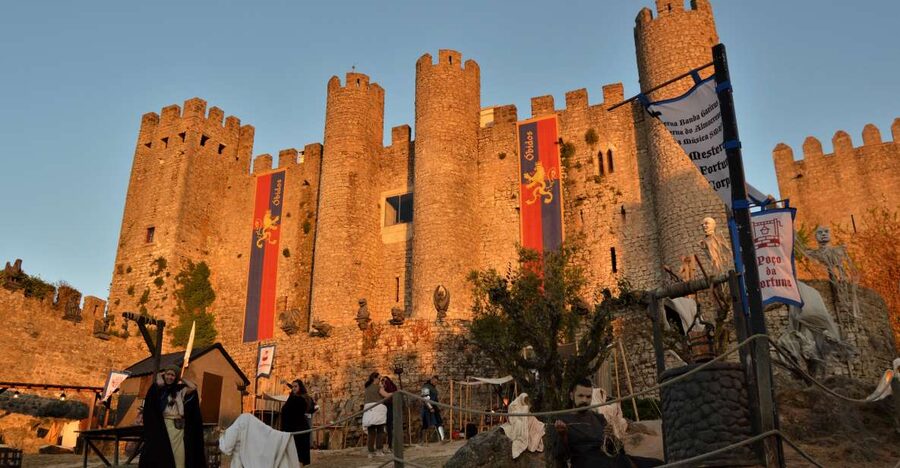
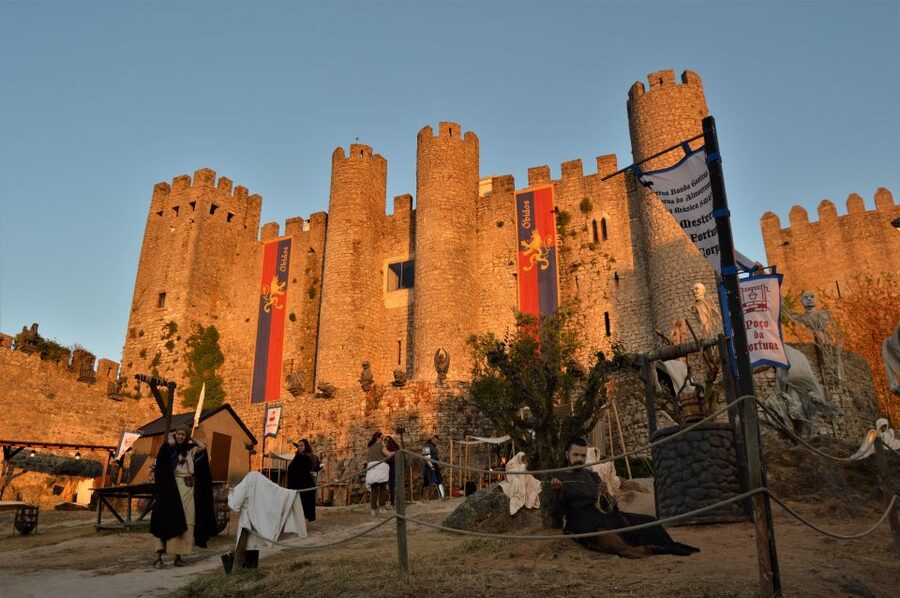
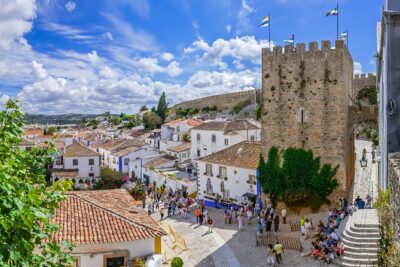
The castle is the main historical anchor of the walk. It is described as a 1,300-year-old Muslim castle, with later changes reflecting the long Portuguese and medieval story of Óbidos.
You visit the castle area with the guide rather than simply walking past its walls. Expect explanations about the fortress, its Moorish origin, and its role in the town. Maney’s Tower is another point of interest along the route.
The castle is visually impressive, but the experience is not only about a grand view. Its real value comes from seeing how the fortress, walls, churches, homes, and narrow streets work together. Óbidos makes more sense when you understand it as a defended settlement, not just as a photogenic old town.
The route also includes a walk outside the walls. This gives you a different view of the fortifications and provides a useful break from the tight lanes inside. Bring your camera, but keep one hand free for balance on uneven ground.
Photo stops and the final ginjinha
The tour is designed with photos in mind. Guides may stop at attractive viewpoints and offer to take pictures, a small service that is genuinely helpful when you are traveling as a couple or family and do not want every photo to be a selfie.
The final tasting is a shot of Óbidos ginjinha, a sour cherry liqueur served in a chocolate cup. It is both a drink and a local ritual. You can sip the liqueur, then eat the cup. The chocolate is a neat match for the sharp fruit flavor.
Food is not included beyond the liquor tasting. This matters because two hours of walking can leave you ready for lunch, especially if you are visiting in warm weather. Guides may offer restaurant suggestions, but you should plan your meal separately.
The tasting is brief, so do not book this expecting a food tour. Its strength is that it gives the walk a clear local ending without taking time away from the castle, churches, and streets.
Is $41 good value for two hours?

At $41 per person, the tour is not the cheapest way to walk around Óbidos. You can enter the town on your own without paying for a guide, and many of the streets are easy to explore independently.
The price makes more sense if you want context. You are paying for a live guide, a planned route through several churches and historic areas, access to a set of lesser-known corners, the bookstore visits, and the ginjinha tasting. You also avoid spending your own time working out how the castle, queens, Josefa de Óbidos, and religious buildings connect.
I consider it good value for a first visit, especially if history and art matter to you. It is less compelling for someone who only wants a quick photo stop or prefers to browse at a completely unhurried pace.
The tour’s near-perfect 4.9 rating from 171 reviews reflects a clear pattern: the guides are the main strength. I would book it early in your Óbidos visit, then return later to revisit the lanes, shops, or castle areas that caught your attention.
Who should take this walk?
This tour suits first-time visitors, history fans, art lovers, and families who want a clear introduction to Óbidos without arranging separate visits. It is also a good fit if you prefer stories and conversation to reading plaques at each stop.
Families with different ages can benefit from a guide who adjusts explanations and answers side questions. One guide was specifically praised for making the story clear for a multilingual, multiage family. The tour can also work well for couples because of the photo stops and quieter lanes.
It may not suit you if you have difficulty walking on stone surfaces, need step-free access, or recently had surgery. The route is active, and no claim is made that it is wheelchair accessible.
The experience is also less suited to someone seeking a slow food excursion. You get one tasting, not a series of meals or tastings. Likewise, serious art specialists may want a longer museum visit elsewhere, since the paintings are part of a broader town walk.
Should you book the Óbidos walking tour?
Book it if you want Óbidos to make sense, not just look pretty. The castle, churches, royal connections, Josefa de Óbidos paintings, old neighborhoods, unusual bookstores, and ginjinha tasting fit together well in two focused hours.
I would especially recommend it at the start of your stay, when a guide can point out places you may later revisit. Choose it with comfortable shoes, leave room for questions, and expect a steady walk rather than a lazy wander.
Skip it if you already know Óbidos well, dislike guided schedules, or need easy-access routes. For most first-time visitors who want history, local flavor, and a route beyond the obvious street, the $41 fee is a fair trade for a much fuller understanding of the town.
FAQ
Where does the Óbidos walking tour begin?
It begins in front of the Óbidos Tourist Office, near the main parking area outside the town walls.
How long does the tour last?
The guided walking tour lasts two hours and returns to the Óbidos Tourist Office.
Which languages are available?
The tour is offered in English and Portuguese.
Is ginjinha included?
Yes. The tour includes a tasting of Óbidos ginjinha, served in a chocolate cup.
Is food included?
No. Food is not included, apart from the ginjinha tasting.
Is the tour suitable for wheelchair users?
No. The tour is not suitable for wheelchair users, people with mobility impairments, or people with recent surgeries. Comfortable shoes are recommended because of the uneven stone streets.
Just added in Portugal
- Half day Spa Water Therapy experience at THE SPA at Corinthia Lisbon★ 4.5 · 51 reviews
- Lisbon Cinematic Photoshoot with Top-Rated Photographer★ 5.0 · 76 reviews
- Central Lisbon E-Bike Tour★ 5.0 · 168 reviews
- Small-Group Sailing Tour on the Tagus River from Lisbon★ 5.0 · 78 reviews
- Lisbon Sailing Catamaran Public Cruise with drinks★ 5.0 · 304 reviews
- Alfama and the Castle of Saint George Skip the line Tour★ 5.0 · 53 reviews
- City Centre Run in Lisbon★ 5.0 · 164 reviews
- Boat tours in the Óbidos Lagoon★ 5.0 · 100 reviews
Fátima, Batalha & Nazaré Day Trips, compared.

Three Cities in One Day: Porto, Nazare and Obidos from Lisbon
Read our review →
Fátima, Nazaré, Batalha, and Óbidos Guided Tour
Read our review →
Fatima Batalha Nazaré & Óbidos Small-Group Tour
Read our review →
Fatima, Batalha, Nazare, Obidos – Small Group
Read our review →
Fatima, Nazare, Obidos 8-People Small Group, Day-Tour from Lisbon
Read our review →
Fátima, Batalha, Nazaré, and Obidos Tour by Van
Read our review →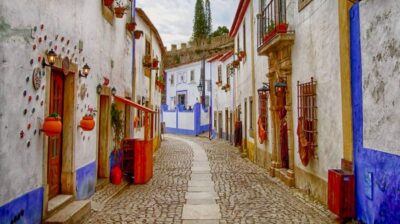
Browse the lists this tour appears in